
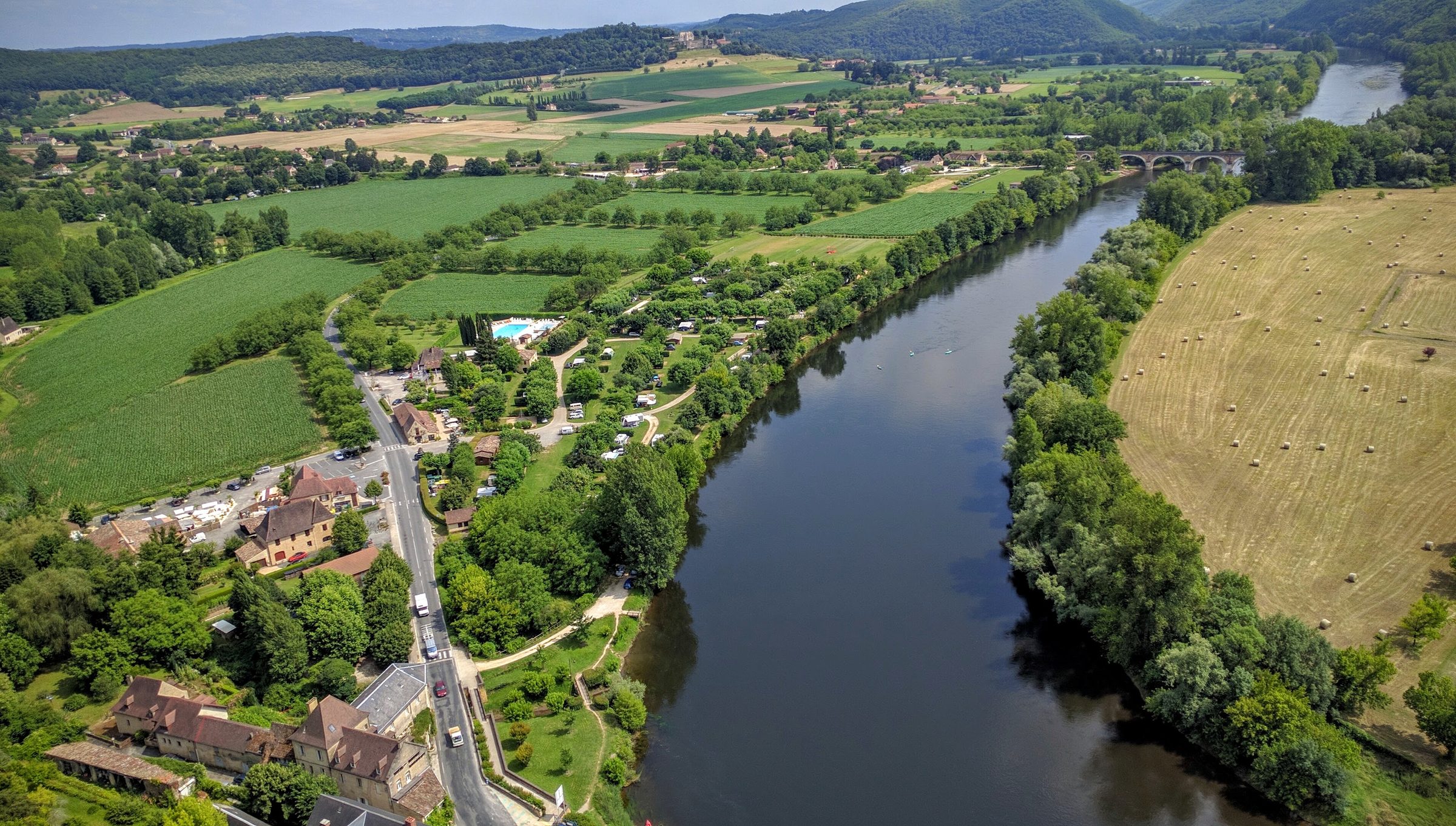
Cycling in the Dordogne is moderate riding on quiet country lanes and riverside cycle paths, 23 to 47 km (14 to 29 miles) a day, with up to 510 m (about 1,650 ft) of climbing on the biggest day. The river valleys are gentle, but the villages and châteaux often sit on top of the hills, and an e-bike makes those climbs much easier.
By Cassie ·
At a glance
Distance
23 to 47 km (14 to 29 miles) a day, often with a shorter or longer option.
Climbing
Up to 510 m (about 1,650 ft) on the biggest day, measured from our GPX tracks.
Surfaces
Quiet country lanes and riverside cycle paths.
Bikes
A hybrid or a road/gravel bike included; e-bike upgrade £140 per person.
Navigation
Detailed route notes and GPX files on your phone.
Support
We’re on hand from 9am to 7pm, UK or French time.
The lie of the land
Cycling in the Dordogne is a circular week from Souillac, graded moderate. The river valleys are gentle, but villages and châteaux often sit on top of the hills, so most days mix gentle valley riding with some climbs and long downhills.
Day 2, Souillac to Sarlat: 32 or 34 km (20 or 21 miles). The longer route follows the Dordogne, mostly on a cycle path; the shorter one is hillier.
Day 3, optional ride to Domme and La Roque-Gageac: 29 or 31 km (18 or 19 miles), with 500 m (about 1,650 ft) of climbing. Domme is a hilltop bastide high above the river.
Day 4, Sarlat to Les Eyzies: 30 or 41 km (19 or 25 miles) of rolling hills past Beynac, with 480 m (about 1,550 ft) of climbing.
Day 7, Montignac to Souillac: 47 km (29 miles), the longest day, with 510 m (about 1,650 ft) of climbing and long downhills, after your visit to Lascaux IV.

Lanes, cycle paths and traffic
We choose our routes for quiet roads, steady distances and long downhills, and our route notes keep to quiet country lanes and cycle paths wherever we can. The first day out of Souillac shows the mix: the longer route follows the Dordogne, mostly on a riverside cycle path, past the Château de Fénelon and the village of Carsac, while the shorter one is hillier.
Lanes are shared with local traffic, so read the French rules of the road below before you set off.

Shorter or longer days, and rest days
There’s a choice of routes on days 2, 4 and 6, so you can ride a shorter or longer day:
Day 2: 34 km (21 miles) by the river, or 32 km (20 miles) over the hills.
Day 4: 30 or 41 km (19 or 25 miles) from Sarlat to Les Eyzies.
Day 6: 23 or 29 km (14 or 18 miles) to Montignac. The shorter option lets you stop at the rock shelters of Castel Merle; the longer runs along the Vézère beneath the cliffs of La Roque Saint-Christophe.
Days 3 and 5 are free days in Sarlat and Les Eyzies, with optional rides: 29 or 31 km (18 or 19 miles) out to Domme and La Roque-Gageac, and 28 km (17 miles) to the Château de Commarque and the Abri du Cap Blanc. Ride them, or rest your legs and explore on foot.
Which bike?
Bike hire is included: a hybrid or a road/gravel bike, with an e-bike upgrade for £140 per person. Most of our cyclists choose an e-bike.
If you cycle regularly and don’t mind a climb, the hybrid suits most riders. If you’re a confident rider who wants something lighter and faster, the road/gravel bike, included at no extra cost, has drop bars but no rack or panniers, so bring a small saddle bag or backpack for the day. If you’d like help on the hills, want to arrive with energy to spare, or ride with someone fitter than you, an e-bike can make the week more relaxed. Our guide to e-bike holidays in the Dordogne explains how a pedal-assist e-bike works and what affects the battery.
How fit do you need to be?
If you enjoy a good day’s cycling, you’ll be fine. On a hybrid or road/gravel bike, these are good, honest days in the saddle; on an e-bike, the climbs feel much easier, leaving more energy for the castles, caves and villages. Our hybrids have 27 gears for the hills, our road/gravel bikes have 20, and the e-bike’s battery is good for up to 100 km (62 miles), more than our longest day.
Our guide How fit do I need to be? compares the distances and biggest climbs of all our holidays.
Finding your way
Our detailed route notes come in digital form, and we also email you GPX files, with simple instructions for using them on your phone, so you can see exactly where you are on the map. Each bike has a holder for your phone. Some sections are waymarked, and your route notes tell you where; the notes and GPS guide you the rest of the way.
Bring a smartphone with mobile data and a power bank. If you take a wrong turn, the GPX track shows you the way back, and we’re a call or WhatsApp away, from 9am to 7pm, UK or French time. Our cycling holiday packing list covers what else to bring.
When to ride
Our season runs from April to October, and you can start any day. Spring brings wildflowers and fresh green valleys, with mild days that can still be showery. June and September are often the sweet spot: warm, settled and quieter. July and August are hot, often 30 °C or more in the afternoon, so set off early, carry plenty of water and plan a long lunch in the shade.
May and September are the months our guests choose most. Our when to go guide goes through the year month by month.

Riding in France
French road rules apply to everyone on a bike. The main ones, from the French government’s official guidance:
- Brakes and bell: a bike must have two working brakes, front and rear, and a bell.
- Lights and reflectors: at night, or by day when visibility is poor, you need a white or yellow front light and a red rear light, and a bike must carry reflectors.
- High-visibility vest: outside built-up areas, at night or when visibility is poor, every rider must wear one.
- Helmet: compulsory for children under 12; over 12 it isn’t compulsory, but strongly recommended.
- Headphones and phones: don’t wear headphones or an earpiece, or hold your phone, while riding.
- Riding together: ride no more than two abreast, and drop into single file at night, when a vehicle is overtaking you, or where the road is narrow.
- Pavements: don’t ride on them; only children under 8 may.
- Red lights: stop at red lights, unless a sign says cyclists may go on.
- Signals: hold out your arm before you turn or overtake.
- Bends: keep well to the right in bends, as drivers may only see you at the last moment.
Drivers must leave at least a metre when they overtake you in town, and a metre and a half outside built-up areas. The drink-drive rules apply on a bike too.
Getting there and the bikes
Cycling in the Dordogne starts and finishes in Souillac, which is on the main line from Paris Austerlitz to Toulouse, about 5 hours from Paris by train. Your bikes are delivered to your first hotel at about 6pm on your arrival day (or 9am the next morning if you arrive later). You return your bike in Souillac at the end of the week.
Our getting there guide has the trains, flights and taxis for this holiday.
Which holidays go there
Everything on this page is about Cycling in the Dordogne, our self-guided week by bike from Souillac. See all our cycling holidays in the Dordogne.
Questions
Is cycling in the Dordogne hilly?
Cycling in the Dordogne has some hills: the river valleys are gentle, but villages and châteaux often sit on top of the hills. The biggest day has 510 m (about 1,650 ft) of climbing, with long downhills after the climbs.
Do I need an e-bike?
An e-bike isn’t essential on Cycling in the Dordogne: a hybrid or a road/gravel bike is included, and on either one these are good, honest days in the saddle. An e-bike makes the climbs much easier, for £140 per person, and most of our cyclists choose one.
Are the roads busy?
Cycling in the Dordogne keeps to quiet country lanes and cycle paths wherever we can, as we choose our routes for quiet roads. The lanes are shared with local traffic, so ride by the French rules of the road.
Can I do it if I don’t cycle much at home?
Cycling in the Dordogne is graded moderate, at 23 to 47 km (14 to 29 miles) a day with some hills. If you don’t cycle much at home, an e-bike makes the climbs much easier, and the free days in Sarlat and Les Eyzies let you rest. Talk to Cassie before you book and she’ll help you choose.
More to read
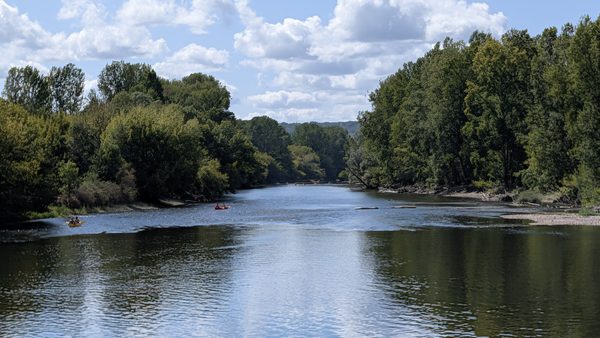
What to pack for a self-guided cycling holiday in France
Cycling holiday packing list: helmet, padded shorts, layers, sun and rain gear, water, phone holder and power bank, plus how luggage and the bikes work.
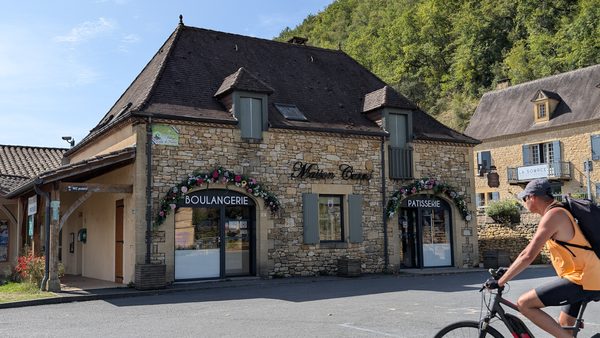
E-bike holidays in the Dordogne
How pedal-assist e-bikes work, the hills on our Cycling in the Dordogne route, battery charging at every hotel and the £140 per person upgrade.

How fit do I need to be for a walking holiday in the Dordogne?
How hard are our walking and cycling holidays? Daily distances, the biggest climb of each holiday and what each activity level means, from our own GPX tracks.

When to go walking or cycling in the Dordogne
When to go walking or cycling in the Dordogne and the Ardèche, month by month from April to October, with the weather and the markets along the way.

Visiting Lascaux and the Vézère valley caves
Can you visit the real Lascaux cave? No, but Lascaux IV is a full replica. How to book, when to go, and the original painted caves nearby, like Font-de-Gaume.
Not sure which holiday suits you?
See our self-guided walking holidays in France and our cycling holidays in the Dordogne, or tell Cassie a little about how you like to walk or ride and she’ll suggest a holiday. We reply within 24 hours, usually much sooner.

Premium Périgord
A Gourmet Journey
4.6 to 15.1 km (2.9 to 9.4 miles) a day · Easy to moderate
6 days · from £950 per person, sharing a double/twin room

Castles & Caves of the Dordogne
12.8 to 16.8 km (8 to 10 miles) a day · Moderate
8 days · from £1,075 per person, sharing a double/twin room

France’s Most Beautiful VillagesLes Plus Beaux Villages de France
15.5 to 23 km (10 to 14 miles) a day · Moderate
8 days · from £995 per person, sharing a double/twin room

Exploring Rocamadour
11.2 to 20.1 km (7 to 12 miles) a day · Moderate
8 days · from £1,025 per person, sharing a double/twin room

Ardèche Adventure
13 to 23.2 km (8 to 14 miles) a day · Challenging
8 days · from £1,095 per person, sharing a double/twin room

Six Villages to Rocamadour
New for 202717.9 to 23 km (11 to 14 miles) a day · Moderate
6 days · from £850 per person, sharing a double/twin room

Loubressac Walking Week
New for 202711.2 to 20.3 km (7 to 13 miles) a day · Moderate
8 days · from £1,175 per person, sharing a double/twin room

The Great Dordogne Walk
New for 202711.2 to 20.1 km (7 to 12 miles) a day · Moderate
14 days · from £1,995 per person, sharing a double/twin room

Cycling in the Dordogne
23 to 47 km (14 to 29 miles) a day · Moderate
8 days · from £1,250 per person, sharing a double/twin room
Sources
- Dordogne Experience, Cycling in the Dordogne (distances, climbs, route options, route finding, weather) (dordogneexperience.com)
- Dordogne Experience, Cycling holidays (quiet roads, support hours) (dordogneexperience.com)
- Dordogne Experience, E-bike holidays in the Dordogne (the hills on the route) (dordogneexperience.com)
- Dordogne Experience, When to go (dordogneexperience.com)
- Dordogne Experience, Getting there (dordogneexperience.com)
- Service-Public.gouv.fr, Équipements obligatoires à vélo (brakes, bell, lights, reflectors, vest, helmet under 12) (service-public.gouv.fr)
- Sécurité routière, Circuler à vélo en toute sécurité (leaflet: headphones, riding in a group, pavements, red lights, signals, bends, overtaking distances) (securite-routiere.gouv.fr)