
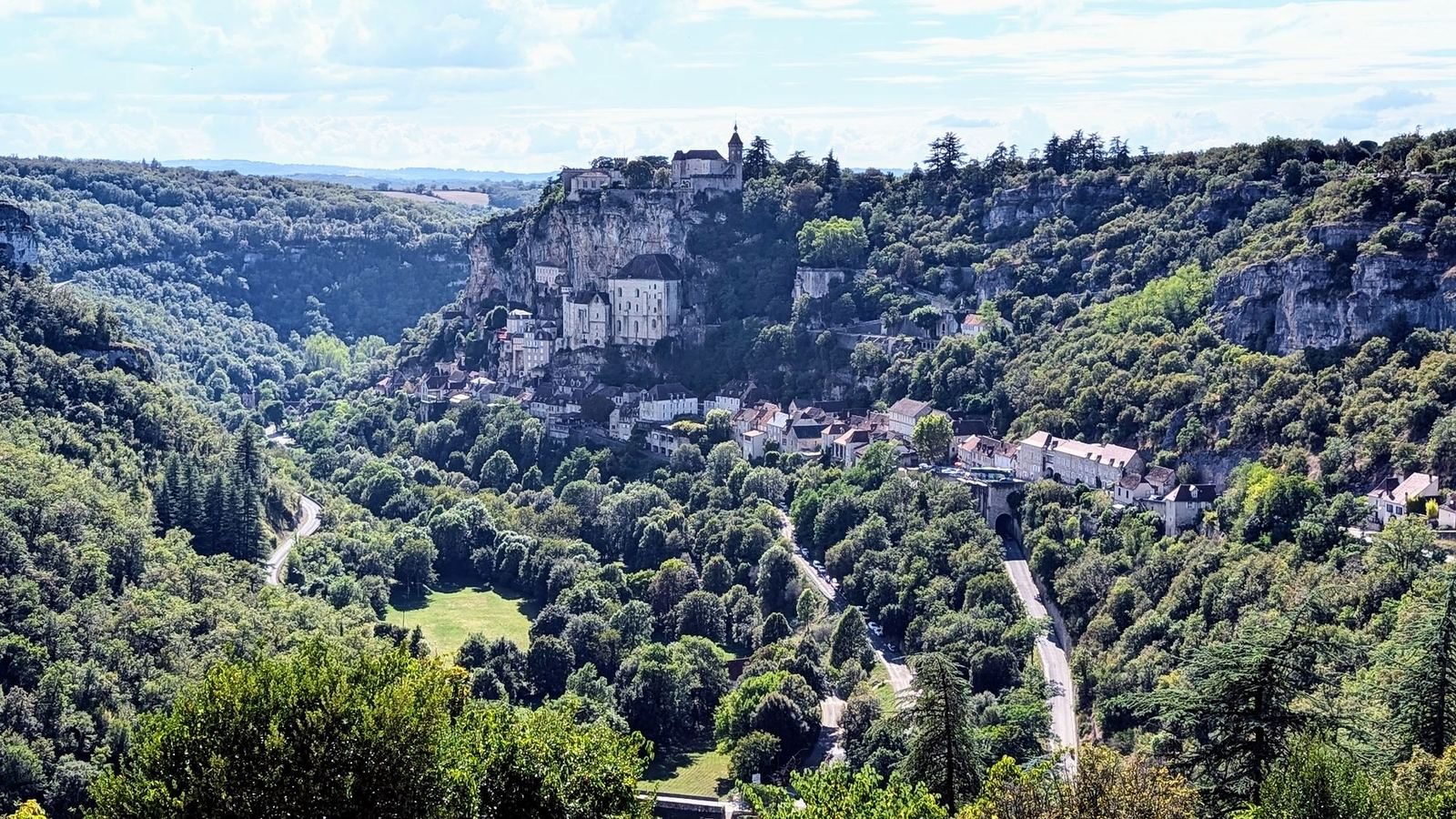
Rocamadour is a medieval pilgrimage town built in tiers up a cliff above the Alzou canyon in the Lot, with the sanctuaries halfway up and a château on top. Give it a full day, climb at least one way on foot, and be there early in the morning or in the evening, when the day visitors have gone.
By Cassie ·
The sanctuaries and the Black Madonna
Eight churches and chapels are built into the cliff around a small square. Pilgrims were already being welcomed here in the early 12th century, and in 1166 a well-preserved body found in the rock was identified as Saint Amadour. Henry II of England came in 1159 and 1170, and Louis IX in 1244.
The heart of it is the Chapelle Notre-Dame, home of the Black Madonna, a walnut statue from the late 12th or early 13th century. She was first painted, with a pink face and a green throne, and only darkened centuries later. Look up for the small bell, which may date from the 9th century and is said to ring by itself whenever Our Lady saves a sailor at sea. Outside, above the chapel door, legend says Roland’s sword Durandal lodged in the rock. The sword that hung there was stolen in June 2024, and the theft made news around the world.
The basilica of Saint-Sauveur and the crypt of Saint-Amadour are part of the UNESCO World Heritage listing for the routes to Santiago de Compostela. Rocamadour sits on a variant of the Way of St James: pilgrims on the Le Puy route (Via Podiensis) can detour north through it, following the GR 6 in from Figeac and the GR 652 west towards Gourdon. These are working churches, so dress and speak as you would in any place of worship.


The pilgrims’ stairway
The Grand Escalier has 216 steps from the village street up to the sanctuaries. Pilgrims climbed it on their knees, saying a Hail Mary on every step. Saint Louis and Blanche of Castile made the climb, and so did the composer Francis Poulenc, who went on to write his Litanies à la Vierge noire.

The Chemin de Croix to the château ramparts
From the sanctuaries, the Way of the Cross climbs the hillside to the château, past 14 stations. It is newer than it looks: the path was opened in 1860 and made a Way of the Cross in 1887, ending in an old quarry.
At the top, the château was rebuilt in the 19th century on medieval fortifications. The château itself isn’t open to visitors, but its ramparts, the remains of a 14th-century fort, are. They give a wide view over the Alzou canyon and the roofs below. There is a small charge, paid at a machine, so check the tourist office site before you go and carry some change.


The view from L’Hospitalet
L’Hospitalet, on the plateau, takes its name from the “little hospital” where pilgrims were cared for, and had their feet washed on arrival. Only ruins of the 13th-century hospital remain, but the viewpoint gives the classic picture of Rocamadour stacked against its cliff. It is worth seeing by night as well as by day. A short loop path links the château, L’Hospitalet and the village, so you can take it in on foot.

Arriving on foot
Walkers on Exploring Rocamadour arrive on day 3, walking 14.1 km (8.8 miles) from St Sozy through woods and fields, with the Auvergne mountains on the horizon on a clear day.
Day 4 is yours: explore the town, or follow the 10.8 km (6.7 miles) circular walk, waymarked by snails carved into the rocks.


Seeing it without the crowds
Rocamadour is one of the most visited sites in France, so timing matters. It is one of the Grands Sites Occitanie, the region’s list of its major sites. Once the day visitors leave in the evening, the town becomes almost intimate. With two nights here, you can:
- climb the Grand Escalier early, before it gets busy;
- save the ramparts and the Chemin de Croix for the middle of the day;
- walk to L’Hospitalet in the evening for the view.
July and August are the busiest months. In late September the Montgolfiades hot-air balloon festival brings big crowds; check the tourist office for dates. Small hotels fill early for May, June and September, so book ahead.

Rocamadour cheese
Rocamadour is also a small goat’s cheese, made from raw whole goat’s milk, about 35 g each and ripened for at least six days. Its name appears in a lease of 1451, which set dues to be paid in cheese. Long sold as cabécou de Rocamadour, it became an AOC in 1996 and is now protected as an AOP. Try it with walnuts, the local way.

Practical tips
- Wear comfortable shoes: there are steep steps and paths.
- Two lifts save your knees: a vertical lift from the village street up to the sanctuaries, and an inclined lift from the sanctuaries up to the château and the car park on the plateau. Check times and fares with the tourist office.
- On Exploring Rocamadour, the second night here is bed and breakfast, so you can choose where to eat in town.

Which holidays go there

Questions
How many steps does Rocamadour have?
The Grand Escalier, the pilgrims’ stairway to the sanctuaries, has 216 steps.
How long do you need in Rocamadour?
A full day lets you see the sanctuaries, the Chemin de Croix, the ramparts and L’Hospitalet without rushing. Exploring Rocamadour gives you two nights and a free day.
Can you visit Rocamadour without climbing the steps?
Yes. A lift runs from the village street to the sanctuaries, and an inclined lift from the sanctuaries to the château. Check times and fares with the tourist office.
When is Rocamadour quietest?
Early in the morning and in the evening, after the day visitors leave. July and August are the busiest months.
What is Rocamadour cheese?
A small raw goat’s milk cheese, about 35 g, protected as an AOP.
More to read
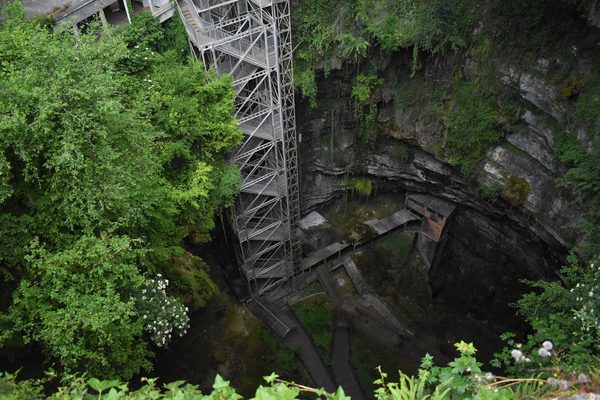
The Gouffre de Padirac
The Gouffre de Padirac is a vast chasm in the Lot with a boat trip on an underground river. How to visit, what to bring and which walks pass it.
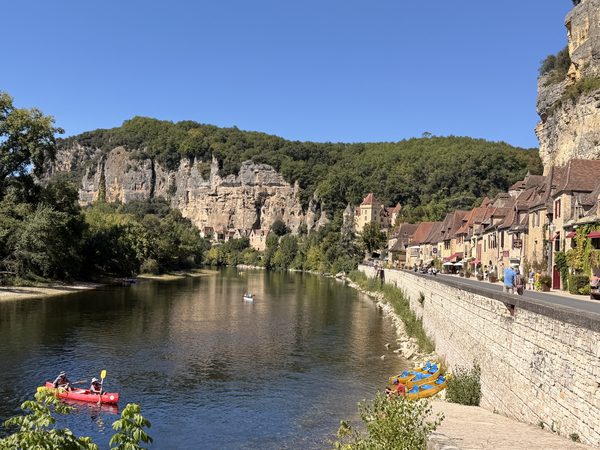
What you’ll see on our routes, day by day
Castles, caves, bastides and cliff villages: the sights on each of our Dordogne walking and cycling holidays, stop by stop, with what makes each special.

Hidden gems of the Dordogne
Cassie’s hidden gems of the Dordogne: the Château de Castelnau, Beaulieu from across the river, Domme’s boutique shops and the Rocamadour circular walk.

When to go walking or cycling in the Dordogne
When to go walking or cycling in the Dordogne and the Ardèche, month by month from April to October, with the weather and the markets along the way.

How fit do I need to be for a walking holiday in the Dordogne?
How hard are our walking and cycling holidays? Daily distances, the biggest climb of each holiday and what each activity level means, from our own GPX tracks.
Sources
- Office de Tourisme Vallée de la Dordogne, Rocamadour visitor guide (PDF, in French) (tourisme-lot.com)
- Tourisme Occitanie, Rocamadour Vallée de la Dordogne (tourisme-occitanie.com)
- Tourisme Occitanie, Sanctuaire de Rocamadour (tourisme-occitanie.com)
- Visit Occitanie, Remparts de Rocamadour (visit-occitanie.com)
- Visit Occitanie, Rocamadour tourist office (visit-occitanie.com)
- Le Routard, Rocamadour: un bijou dans la vallée de la Dordogne (routard.com)
- Remontées Mécaniques, Rocamadour inclined lift (remontees-mecaniques.net)
- INAO, Rocamadour AOP specification (PDF, in French) (extranet.inao.gouv.fr)
- Wikipedia, Via Podiensis (Rocamadour variant) (en.wikipedia.org)
- France.fr, Rocamadour, the village on the cliff (216 steps, UNESCO, Grand Site in Occitanie) (france.fr)
- Wikipedia, Rocamadour (Henry II 1159, 1166 discovery, Poulenc, L’Hospitalet, Durandal reported stolen June 2024) (en.wikipedia.org)
- Wikipedia (French), Label Grand Site de France (Rocamadour not in the list of labelled sites) (fr.wikipedia.org)
- Sites et Cités remarquables, Grand Site de Rocamadour job notice (Opération Grand Site since 2011) (sites-cites.fr)
- Frommer’s, Rocamadour attractions (two lifts, ramparts fee paid at a machine, château interior closed) (frommers.com)
- Le Long Weekend, Visiting Rocamadour (lift from lower village to sanctuaries, L’Hospitalet loop, climb early, ramparts fee, castle interior closed, balloon festival late September) (lelongweekend.com)
- The Geographical Cure, Rocamadour in one day (two lifts, 216 steps, Miraculous Bell 9th century, Durandal missing 2024) (thegeographicalcure.com)
- Smithsonian Magazine, Fabled sword disappears (June 2024) (smithsonianmag.com)
- Le Journal Toulousain, Durandal theft, not found as of May 2025 (lejournaltoulousain.fr)
- Office de Tourisme Vallée de la Dordogne, Ascenseur incliné Solveroc (vallee-dordogne.com)
- Walking in France, Rocamadour variant of the Way of St James (GR 652 and GR 46 west of Rocamadour) (walkinginfrance.info)
- Camino de Santiago forum, Figeac to Rocamadour variant along the GR 6 (caminodesantiago.me)
- Wikipedia, Rocamadour cheese (35 g, raw whole goat’s milk, AOC 16 March 1996, name recorded 1451) (en.wikipedia.org)
- INAO, Rocamadour AOP single document (PDF, in French) (extranet.inao.gouv.fr)
- Office de Tourisme Vallée de la Dordogne, Montgolfiades circular (September 2025) (vallee-dordogne.com)
- Dordogne Experience, Exploring Rocamadour route notes and holiday page (/rocamadour)