
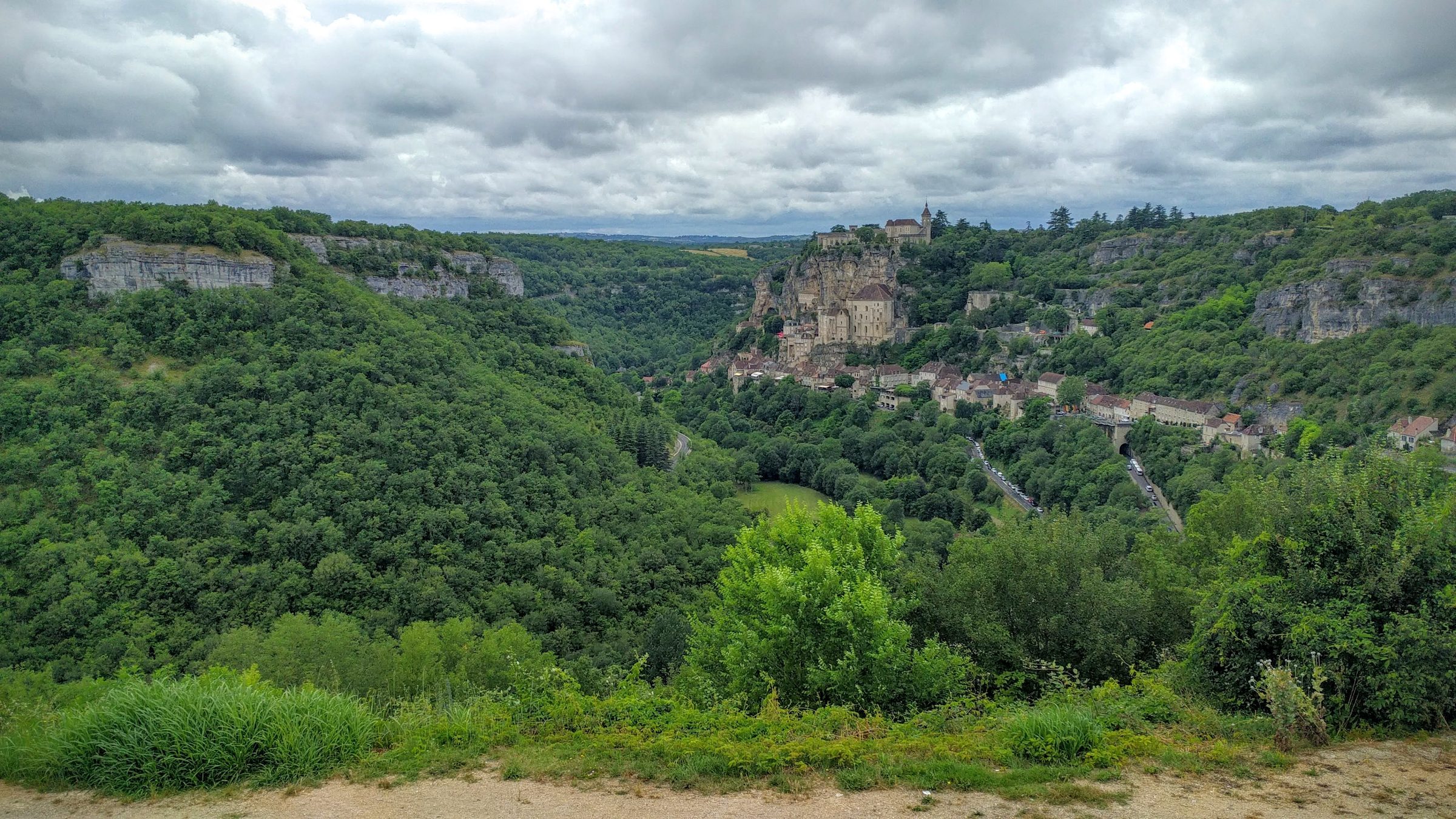
Rocamadour has been a major pilgrimage site since the Middle Ages. In 1166, the discovery of an intact body, said to be that of the hermit Saint Amadour, turned a small shrine to the Virgin on a cliff above the Alzou into one of the great pilgrimages of medieval Europe. Rocamadour’s Basilica of Saint-Sauveur and the Crypt of Saint-Amadour are part of the UNESCO World Heritage listing “Routes of Santiago de Compostela in France”. Walkers still arrive on the long-distance paths, and on Exploring Rocamadour and The Great Dordogne Walk you walk in too, following the white and red marks of the GR 46 for the second half of the day from St Sozy. Our holidays aren’t pilgrimages: they are self-guided walks that bring you to Rocamadour on foot.
For visiting the sanctuaries, the Black Madonna and the town itself, see our Rocamadour visitor guide.
By Cassie ·
At a glance
Since 1166
The finding of an intact body, said to be Saint Amadour’s, began the great pilgrimage.
216 steps
Pilgrims climbed the great stairway on their knees.
UNESCO
The Basilica of Saint-Sauveur and the Crypt of Saint-Amadour are part of the Routes of Santiago de Compostela in France.
L’Hospitalet
The pilgrims’ village, with the classic view of Rocamadour
Waymarks
The second half of the walk from St Sozy follows the white and red marks of the GR 46.
Saint Amadour and the finding of the body
From very early times a small chapel to the Virgin stood halfway up the cliff, looked after by a few Benedictine monks. In 1166 the intact body of a hermit was found in front of the chapel of Notre-Dame and attributed to Saint Amadour, whom the sanctuary describes as one of the first hermits here and a servant of the Virgin Mary.
Who Amadour really was is not clearly known. In 1180 the chronicler Robert de Torigni described him as the servant of the Virgin, and a later legend, from the 15th century, linked him to Zacchaeus of the Gospels. In 1562, during the Wars of Religion, the sanctuary was pillaged and the body burned. For the 850th anniversary of the discovery, in 2016, bones said to have been saved were placed in a new reliquary.


The medieval pilgrimage
Pilgrims were already coming in 1105, when Pope Paschal II mentioned the pilgrimage, and after 1166 Rocamadour entered its golden age. In 1172 the monks recorded 126 miracles in a Book of Miracles, most of them healings, and by the 13th century Rocamadour had become the greatest pilgrimage to the Virgin in the Western world. The focus was, and still is, the Black Madonna in the Chapelle Notre-Dame, a 12th-century statue of the Virgin and Child to whom many miracles were attributed.
The sanctuary lists among its pilgrims Henry II Plantagenet, Simon de Montfort, Blanche of Castile and her son Saint Louis, every king of France up to Louis XI, Saint Dominic, Saint Bernard and Saint Anthony of Padua, and, in the 20th century, the composer Francis Poulenc. The wealth they brought paid for the shrines, the village, a pilgrim hospital and the castle and ramparts.
Climbing the steps on your knees
The Grand Escalier, the great stairway of 216 steps, was used very early on as a path of penance. Pilgrims climbed it on their knees, stopping on each step to say a Hail Mary, and some climbed in chains: two of those chains still hang in the Chapelle Notre-Dame. Many pilgrims keep up the tradition today, climbing the stairway on their knees as they pray the rosary.
The sanctuary in the cliff
The sanctuary clings to a cliff 150 m (about 500 ft) above the Alzou valley, built under and in front of a huge rock overhang. The Crypt of Saint-Amadour is a lower church from the 12th century, where the relics were shown to medieval pilgrims; it isn’t underground, but stands on a ledge of rock. The Basilica of Saint-Sauveur, the largest building in the sanctuary, rests on its vault, with two naves divided by pillars because of the cliff.
Rocamadour’s Basilica of Saint-Sauveur and the Crypt of Saint-Amadour are part of the UNESCO World Heritage listing “Routes of Santiago de Compostela in France”. The listing was inscribed in 1998.
L’Hospitalet, the pilgrims’ village
L’Hospitalet, on the plateau above Rocamadour, takes its name from the Occitan for “little hospital”. Here, at the hospital of Saint-Jean, pilgrims were taken in as they arrived and had their feet washed; only ruins remain of the 13th-century building. From L’Hospitalet, the Voie Sainte, the holy way, led down to the sanctuary and was the main way in, and pilgrims still walk down it before climbing the stairway.
The viewpoint, the belvédère, in L’Hospitalet gives the classic view of Rocamadour across the valley, and the Lot tourist board puts it first among the viewpoints of the Lot.


The pilgrim routes
Rocamadour lies on a branch of the Way of St James to Santiago de Compostela, not on the main route:
The Le Puy route: the Via Podiensis, the GR 65, runs from Le Puy-en-Velay to Saint-Jean-Pied-de-Port. At Figeac, pilgrims choose between the classic route via Cajarc and the alternative via Rocamadour.
The Rocamadour alternative: from Figeac, the GR 6 leads about 57 km (35 miles) to Rocamadour through Gramat. From Rocamadour, the GR 64 and GR 652 cross the Causse de Gramat, the Haut-Quercy and the Agenais to rejoin the GR 65 at La Romieu in the Gers; pilgrims can also reach the Le Puy route at Cahors in three stages.
The Voie de Rocamadour: pilgrims coming from the Limousin walk down to Rocamadour through Collonges-la-Rouge and Martel.
The GR 46: the long-distance path from Tours to Toulouse comes through Martel and Montvalent to Rocamadour, then heads south towards Labastide-Murat.
The GR 652 in the Dordogne valley: it runs through Autoire, Loubressac and Carennac on its way to Rocamadour.
Long-distance paths in France, the GRs, are waymarked in white and red.
Walking to Rocamadour on our holidays
On Exploring Rocamadour and The Great Dordogne Walk, you walk 14.1 km (8.8 miles) from St Sozy to Rocamadour, leaving the river valley to cross the Causse, the limestone plateau, through woods and fields. Yellow waymarks guide you at first, then for the second half you follow the white and red marks of the GR 46. You arrive in L’Hospitalet, and your route notes suggest a few minutes at the belvédère for the classic view before you go on to your hotel; you then have two nights in Rocamadour.
Six Villages to Rocamadour ends by walking across the causse from Loubressac, past the Gouffre de Padirac and through Miers, to a hotel at L’Hospitalet with views across to the town. Loubressac Walking Week has a day in Rocamadour and a walk from Rocamadour back to Loubressac.
Good to know: our holidays aren’t pilgrimages and don’t follow the Way of St James. They are self-guided walks from one hotel to the next, with your luggage carried and your hotels booked, that bring you to Rocamadour on foot as pilgrims once arrived.
Which holidays go there
Four of our walks reach Rocamadour on foot or spend time there.

Exploring Rocamadour
8 days · from £1,025 per person, sharing a double/twin room
Day 3: St Sozy to Rocamadour, the second half on the GR 46, then two nights.

Six Villages to Rocamadour
New for 20276 days · from £850 per person, sharing a double/twin room
Ends with the walk across the causse to L’Hospitalet.

Loubressac Walking Week
New for 20278 days · from £1,175 per person, sharing a double/twin room
A day in Rocamadour, and the walk back to Loubressac.

The Great Dordogne Walk
New for 202714 days · from £1,995 per person, sharing a double/twin room
Day 9: St Sozy to Rocamadour, then two nights.
Questions
Is Rocamadour on the Camino de Santiago?
Rocamadour is on a branch of the Camino de Santiago, the Way of St James: an alternative to the Le Puy route that leaves it at Figeac and rejoins it at La Romieu. Rocamadour’s Basilica of Saint-Sauveur and the Crypt of Saint-Amadour are part of the UNESCO World Heritage listing “Routes of Santiago de Compostela in France”.
Why do pilgrims climb the steps on their knees?
Rocamadour’s great stairway of 216 steps was used very early on as a path of penance: pilgrims climbed it on their knees, saying a Hail Mary on each step, and some still do today.
Is your Rocamadour holiday a pilgrimage?
Exploring Rocamadour isn’t a pilgrimage and doesn’t follow the Way of St James. It is a self-guided walk from hotel to hotel that brings you to Rocamadour on foot, with the second half of the day from St Sozy on the GR 46.
Who was Saint Amadour?
Saint Amadour is said to have been a hermit and a servant of the Virgin Mary. His identity isn’t clearly known: an intact body attributed to him was found in front of the chapel of Notre-Dame in 1166.
More to read
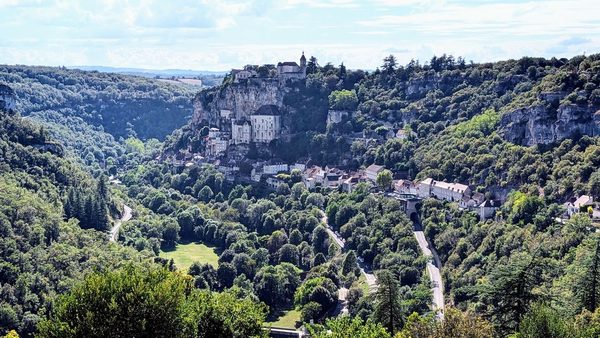
Rocamadour: a visitor’s guide
How to see Rocamadour: the Black Madonna, the 216-step Grand Escalier, the lifts, the view from L’Hospitalet and the quiet hours.
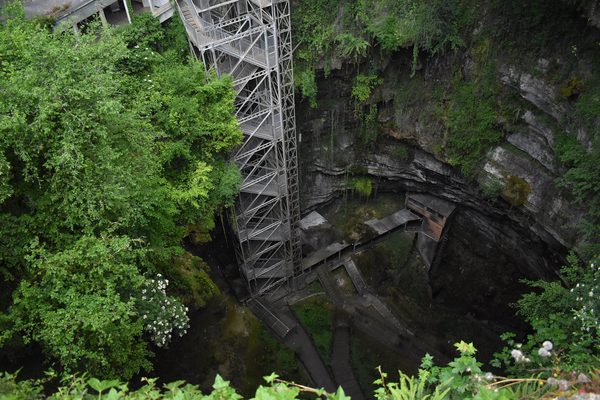
The Gouffre de Padirac
Padirac Cave: book online for a set day and time, as summer is often fully booked. The underground boat trip, how long to allow and our walks nearby.

The most beautiful villages in the Dordogne
Golden-stone villages under clifftop castles, a whole village built of red sandstone, and a pilgrimage town stacked up a cliff: the villages our holidays are built around.
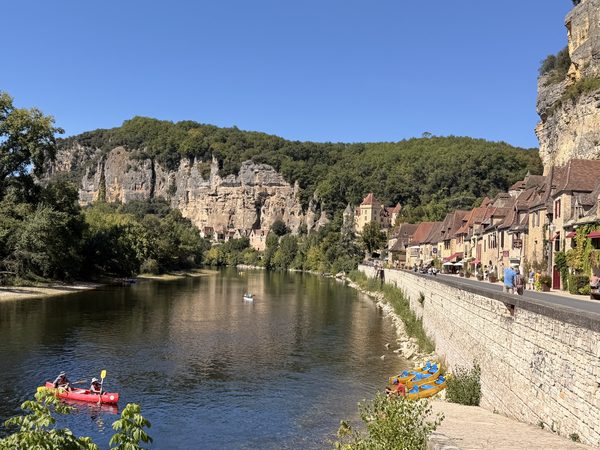
What you’ll see on our routes, day by day
Castles, caves, bastides and cliff villages: the sights on each of our Dordogne walking and cycling holidays, stop by stop, with what makes each special.
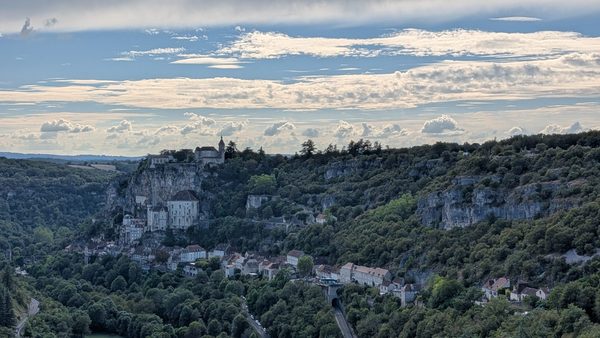
Exploring Rocamadour
A self-guided walking tour to Rocamadour, UNESCO-listed on the Routes of Santiago de Compostela in France, then Padirac. Start any day. 8 days from £1,025.
Not sure which holiday suits you?
See our self-guided walking holidays in France and our cycling holidays in the Dordogne, or tell Cassie a little about how you like to walk or ride and she’ll suggest a holiday. We reply within 24 hours, usually much sooner.

Premium Périgord
A Gourmet Journey
4.6 to 15.1 km (2.9 to 9.4 miles) a day · Easy to moderate
6 days · from £950 per person, sharing a double/twin room

Castles & Caves of the Dordogne
12.8 to 16.8 km (8 to 10 miles) a day · Moderate
8 days · from £1,075 per person, sharing a double/twin room

France’s Most Beautiful VillagesLes Plus Beaux Villages de France
15.5 to 23 km (10 to 14 miles) a day · Moderate
8 days · from £995 per person, sharing a double/twin room
Exploring Rocamadour
10.2 to 20.1 km (6 to 12 miles) a day · Moderate
8 days · from £1,025 per person, sharing a double/twin room

Ardèche Adventure
13 to 23.2 km (8 to 14 miles) a day · Challenging
8 days · from £1,095 per person, sharing a double/twin room
Six Villages to Rocamadour
New for 202717.9 to 23 km (11 to 14 miles) a day · Moderate
6 days · from £850 per person, sharing a double/twin room
Loubressac Walking Week
New for 202710.2 to 20.3 km (6 to 13 miles) a day · Moderate
8 days · from £1,175 per person, sharing a double/twin room
The Great Dordogne Walk
New for 202710.2 to 20.1 km (6 to 12 miles) a day · Moderate
14 days · from £1,995 per person, sharing a double/twin room

Cycling in the Dordogne
23 to 47 km (14 to 29 miles) a day · Moderate
8 days · from £1,250 per person, sharing a double/twin room
Sources
- Sanctuary of Rocamadour, presentation (Amadour, one of the first hermits; the cliff) (sanctuairerocamadour.com)
- Sanctuary of Rocamadour, history of the pilgrimage (1105, 1166, 1172, 1244, 1562) (sanctuairerocamadour.com)
- Sanctuary of Rocamadour, history (its famous pilgrims) (sanctuairerocamadour.com)
- Sanctuary of Rocamadour, the Black Madonna (sanctuairerocamadour.com)
- Sanctuary of Rocamadour, the places (216 steps, penance, climbing on the knees, the Voie Sainte from L’Hospitalet) (sanctuairerocamadour.com)
- Sanctuary of Rocamadour, the Way of St James (the alternative from Figeac to La Romieu) (sanctuairerocamadour.com)
- Vallée de la Dordogne tourist office, Rocamadour visitor guide (the legend, 1166 and 1562, the 2016 reliquary, the chains, the crypt and basilica, L’Hospitalet) (tourisme-lot.com)
- Agence des chemins de Compostelle, Cité religieuse, Rocamadour (golden age, the greatest Marian pilgrimage of the West) (chemins-compostelle.com)
- Agence des chemins de Compostelle, the alternative via Rocamadour (GR 6, GR 64, GR 652, La Romieu) (chemins-compostelle.com)
- Agence des chemins de Compostelle, the Le Puy route (GR 65) (chemins-compostelle.com)
- Agence des chemins de Compostelle, the Voie de Rocamadour in the Limousin (Rocamadour to Cahors in three stages) (chemins-compostelle.com)
- Vallée de la Dordogne tourist office, the Way of St James in the Dordogne valley (GR 6, GR 46, GR 652, Voie de Rocamadour) (vallee-dordogne.com)
- Lot Tourisme, the GR 65 and its variants in the Lot 2026 (GR 6 Figeac to Rocamadour, GR 46 stages) (vallee-dordogne.com)
- UNESCO, Routes of Santiago de Compostela in France (inscribed 1998) (whc.unesco.org)
- UNESCO, ICOMOS evaluation (Church of Saint-Sauveur and Crypt of Saint-Amadour) (whc.unesco.org)
- Lot Tourisme, the viewpoints of the Lot (the belvédère at L’Hospitalet) (tourisme-lot.com)
- FFRandonnée Centre-Val de Loire, the GR 46 links Tours and Toulouse (ffrandonnee.fr)
- Mon GR (FFRandonnée), waymarking: white and red for GRs (mongr.fr)
- Dordogne Experience, Exploring Rocamadour, Six Villages to Rocamadour, Loubressac Walking Week and The Great Dordogne Walk, and our route notes for St Sozy to Rocamadour (waymarks, L’Hospitalet) (dordogneexperience.com)