
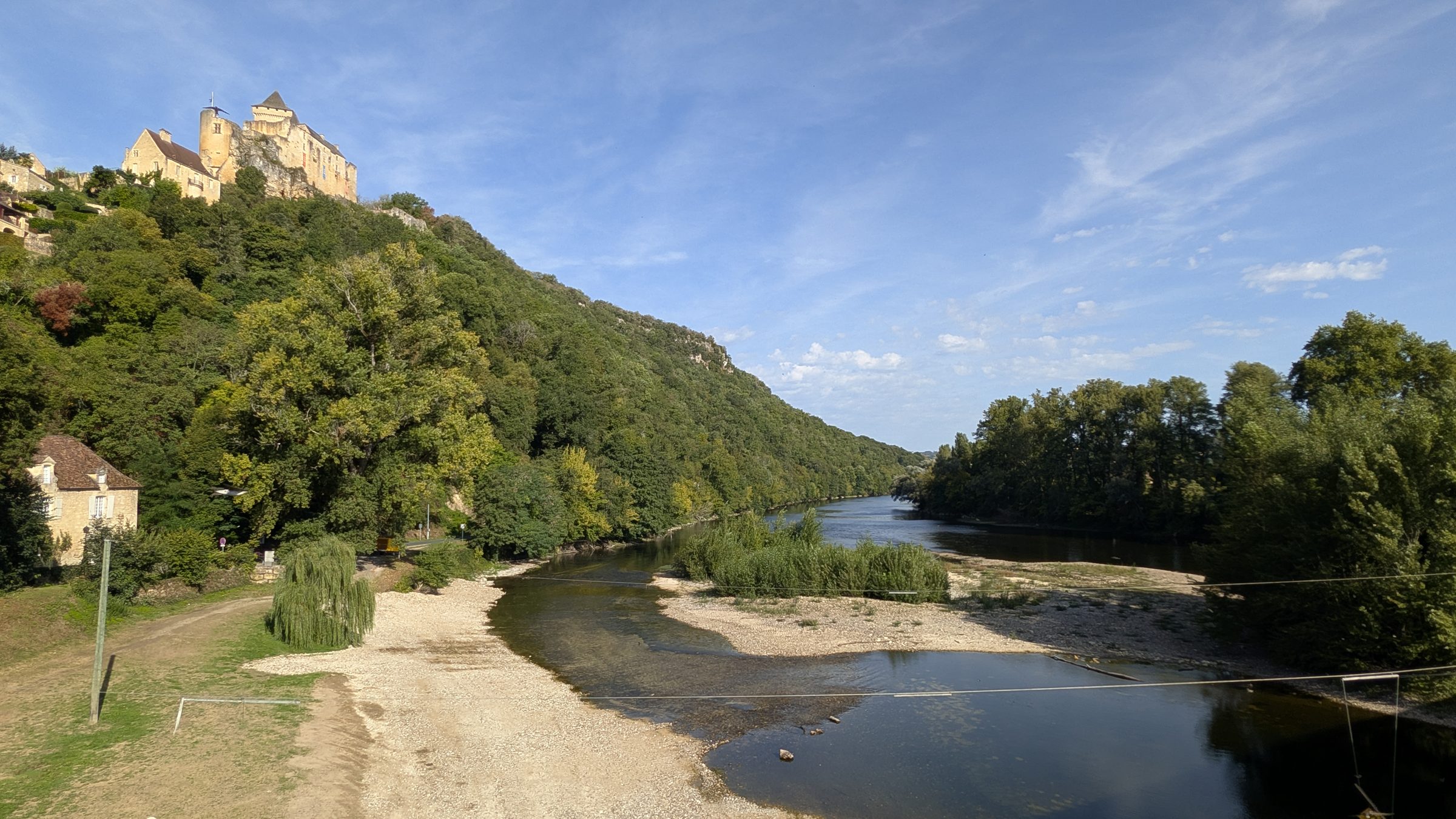
Which Dordogne castle to visit depends on what you enjoy: clifftop fortresses at Beynac, Castelnaud and Castelnau-Bretenoux, Josephine Baker’s home at Milandes, the hanging gardens of Marqueyssac, or Fénelon and its great stone roofs. Montfort is a private home, so you admire it from the path below.
By Cassie ·
Château de Beynac
Beynac has watched over the Dordogne from its limestone cliff, more than 150 metres above the river, since the 12th century. Richard the Lionheart held it in the 1190s, and Eleanor of Aquitaine and Simon de Montfort both passed through. During the Hundred Years’ War Beynac stayed in French hands while Castelnaud, across the river, sided with the English. Inside you’ll find the barbican and ramparts, a 13th-century kitchen with a vast fireplace, the hall where the barons of Périgord met, and the square 12th-century keep, with a view all round the valley. Film fans may recognise it from Les Visiteurs, Chocolat and Luc Besson’s Joan of Arc. Allow one and a half to two hours.
Holidays: Castles & Caves (day 4 ends at Beynac, day 5 starts there) and Cycling in the Dordogne (day 4).


Château de Castelnaud
Across the river from Beynac, its historic rival, Castelnaud stands on a rocky spur. Simon de Montfort took the first castle in 1214, during the crusade against the Cathars, and it was rebuilt in the 13th century. In the Hundred Years’ War its lords, the Caumonts, sided with the English, and it changed hands several times before the French took it for good. Abandoned from the 18th century, it has been restored since the 1960s and is now a museum of medieval warfare, with about 300 weapons and suits of armour. The castle also has full-size replicas of siege engines, including a trebuchet, and in season there are trebuchet firing demonstrations. It is open every day of the year, and it is a good one for grandchildren.
Holidays: Castles & Caves (day 5), Cycling in the Dordogne (day 4), and Premium Périgord, whose day 2 walk has views of Castelnaud.

Château des Milandes
Milandes was built in 1489 by François de Caumont, lord of Castelnaud, at the wish of his wife, Claude de Cardaillac. Its 20th-century story is the draw. Josephine Baker rented it before the war, used it for her Resistance work, bought it in 1947 and married in its chapel that year. She raised her twelve adopted children here, the “Rainbow Tribe”, until debts forced the sale of the château in 1968. In 2021 she was honoured with a place in the Panthéon in Paris. Today you can see rooms devoted to her life, gardens listed as a Jardin Remarquable and birds of prey displays in front of the château.
Holidays: Cycling in the Dordogne (day 4).

Château de Montfort
Montfort sits on a cliff above an almost perfect loop of the river, the Cingle de Montfort. Simon de Montfort destroyed it in the early 13th century, during the crusade against the Cathars, and it has been rebuilt several times since. It is a private home and not open to visitors, but you see it well from the paths and lanes below.
Holidays: Castles & Caves (day 6 passes beneath it) and Premium Périgord (day 4 passes it on the way to Sarlat).

The gardens of Marqueyssac
Marqueyssac has a château with a stone-slab roof, but people come for its hanging gardens, shaped from the early 19th century by Julien de Cerval. More than 150,000 box plants, many of them over a hundred years old and all clipped by hand, line over 6 km (3.7 miles) of paths. From the belvedere on the rocky spur you look over the river to Beynac, Castelnaud and La Roque-Gageac. On Thursday evenings in July and August the gardens are lit by candles; these evenings need booking, so check the official site. Dogs on a lead are welcome, which helps if yours is walking with you.
Holidays: Castles & Caves (day 5) and Premium Périgord (an option on the day 2 walk).

Château de Castelnau-Bretenoux
In the Lot, at Prudhomat, Castelnau-Bretenoux is a medieval fortress of red sandstone, with a 13th-century keep, high above the Cère and Dordogne valleys. It is looked after by the Centre des monuments nationaux. Jean Mouliérat, a tenor at the Opéra-Comique in Paris, bought it in 1896, spent his fortune restoring it and left it, with his collections, to the State when he died in 1932. Prosper Mérimée called it “a summary of the arts of the Middle Ages”. A visit takes about an hour, and the view takes in the Dordogne valley and the village of Loubressac.
Holidays: France’s Most Beautiful Villages (day 7 optional circular walk from Loubressac) and Exploring Rocamadour (the same walks, on day 6).


Château de Fénelon
Between Sarlat and Souillac, at Sainte-Mondane, Fénelon has a triple wall with eight towers, and one of the most imposing stone lauze roofs in the Périgord Noir. It was the birthplace, in 1651, of François de Salignac de La Mothe-Fénelon, author of Les Aventures de Télémaque and tutor to Louis XIV’s grandson. A great cedar of Lebanon stands before the entrance; tradition says it was planted for his birth. The terraces look out over the Dordogne valley, and Ridley Scott filmed The Last Duel here.
Holidays: Cycling in the Dordogne (day 2, on the riverside route from Souillac to Sarlat).

Choosing between them
- For medieval history and armour: Castelnaud and Beynac, which face each other across the river.
- For a remarkable life story: Milandes.
- For gardens and views: Marqueyssac.
- For a red-stone fortress in the Lot: Castelnau-Bretenoux.
Entrance fees aren’t included on our holidays, and opening times change each year, so check each château’s official site before you go.
Which holidays go there

Castles & Caves of the Dordogne
8 days · from £995 per person, sharing a double/twin room
8 days from £995 (9 and 10 days too). Beynac, Marqueyssac, Castelnaud and Montfort on foot, ending in Sarlat.

Cycling in the Dordogne
8 days · from £1,250 per person, sharing a double/twin room
8 days from £1,250. Fénelon, Beynac, Castelnaud and Milandes by bike. Day 4 is 41 km (25 miles), so choose one or two to visit.

Premium Périgord
A Gourmet Journey
6 days · from £950 per person, sharing a double/twin room
6 days from £950. Views of Castelnaud, an optional visit to Marqueyssac and the walk past Montfort.

France’s Most Beautiful Villages
8 days · from £965 per person, sharing a double/twin room
8 days from £965. Castelnau-Bretenoux on the day 7 walks.

Exploring Rocamadour
8 days · from £975 per person, sharing a double/twin room
8 days from £975. Castelnau-Bretenoux as an option on the day 6 circular walks from Loubressac.
Questions
Can you visit the Château de Montfort?
No. It is a private home, but you can see it from the paths below, as on Castles & Caves and Premium Périgord.
Which castle has the siege engines?
Castelnaud, which houses a museum of medieval warfare with full-size replica siege engines.
Was the Château des Milandes Josephine Baker’s home?
Yes. She bought it in 1947 and raised her twelve adopted children there. Rooms in the château now tell her story.
Are castle entrance fees included?
No. Entrance fees for châteaux, caves, gardens and museums are paid on the day.
More to read
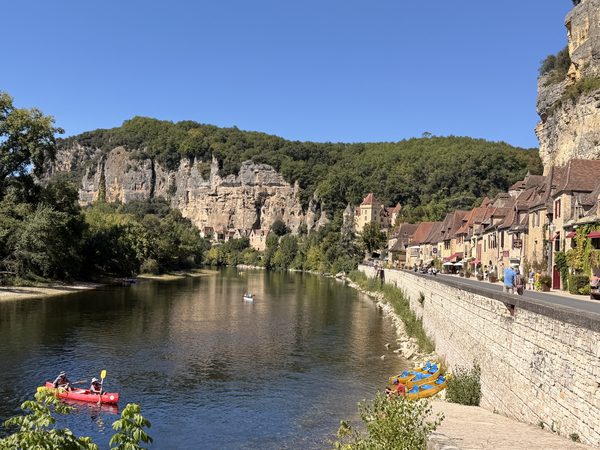
What you’ll see on our routes, day by day
Castles, caves, bastides and cliff villages: the sights on each of our Dordogne walking and cycling holidays, stop by stop, with what makes each special.
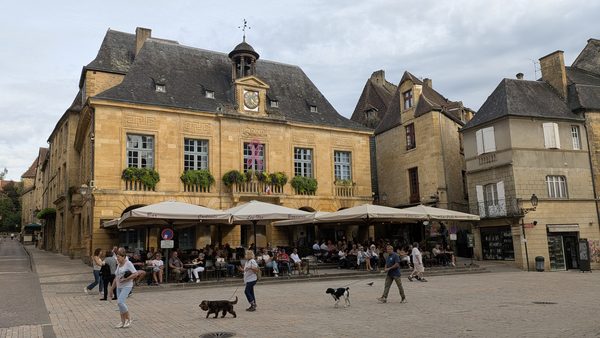
Sarlat-la-Canéda: a guide to the old town, markets and festivals
Sarlat, capital of the Périgord Noir: a walk through the old town, the Wednesday and Saturday markets, the glass lift, festivals and quiet evenings.

The most beautiful villages in the Dordogne
Golden-stone villages under clifftop castles, a whole village built of red sandstone, and a pilgrimage town stacked up a cliff: the villages our holidays are built around.

Hidden gems of the Dordogne
Cassie’s hidden gems of the Dordogne: the Château de Castelnau, Beaulieu from across the river, Domme’s boutique shops and the Rocamadour circular walk.
E-bike holidays in the Dordogne
How pedal-assist e-bikes work, the hills on our Cycling in the Dordogne route, battery charging at every hotel and the £140 per person upgrade.
Sources
- Dordogne Périgord Tourisme, Château de Beynac (dordogne-perigord-tourisme.fr)
- Dordogne Périgord Tourisme, Château de Castelnaud (Châteaux en Fête) (dordogne-perigord-tourisme.fr)
- Château de Castelnaud, schools leaflet 2025 to 2026 (PDF, in French) (castelnaud.com)
- Dordogne Périgord Tourisme, Château des Milandes (dordogne-perigord-tourisme.fr)
- Wikipedia, Château des Milandes (en.wikipedia.org)
- Dordogne Périgord Tourisme, Jardins de Marqueyssac (dordogne-perigord-tourisme.fr)
- Centre des monuments nationaux, 3 châteaux to visit in the Lot (monuments-nationaux.fr)
- Le Routard, Château de Castelnau-Bretenoux (routard.com)
- Dordogne Périgord Tourisme, Château de Fénelon (dordogne-perigord-tourisme.fr)
- Château de Fénelon, official site (chateau-fenelon.fr)
- Wikipedia, Château de Beynac (Richard the Lionheart 1189 to 1199, French side in the Hundred Years’ War, films including The Messenger: The Story of Joan of Arc) (en.wikipedia.org)
- Wikipedia (French), Château de Castelnaud (Simon de Montfort 1214, Caumonts on the English side, changes of hands, restoration from 1965, museum opened 1985, about 300 weapons, siege engine replicas) (fr.wikipedia.org)
- Château de Castelnaud, official site (museum of medieval warfare, full-size siege machines, trebuchet demonstrations, open every day all year) (castelnaud.com)
- Château des Milandes, official site (built 1489 for Claude de Cardaillac by François de Caumont, Josephine Baker rooms, birds of prey) (milandes.com)
- Wikipedia, Josephine Baker (Milandes bought 1947, lost 1968, twelve adopted children, Panthéon 30 November 2021) (en.wikipedia.org)
- Wikipedia (French), Joséphine Baker (rented Milandes from 1937, bought 1947, sold 1968, Panthéon 2021) (fr.wikipedia.org)
- Routard, Le cingle de Montfort (private home, not open to visitors) (routard.com)
- France This Way, Vitrac (Château de Montfort private and not open to the public) (francethisway.com)
- Jardins de Marqueyssac, official site (150,000 hand-clipped box, over 6 km (3.7 miles) of paths, candlelit evenings by booking, dogs on a lead) (marqueyssac.com)
- Wikipedia, François Fénelon (born 6 August 1651 at the Château de Fénelon, tutor to the Duke of Burgundy) (en.wikipedia.org)
- Dordogne Experience holiday pages (/vezere-valley, /cycling-dordogne, /premium-perigord, /plus-beaux-villages, /rocamadour)
- Paris ZigZag, Château de Fénelon (pariszigzag.fr)