
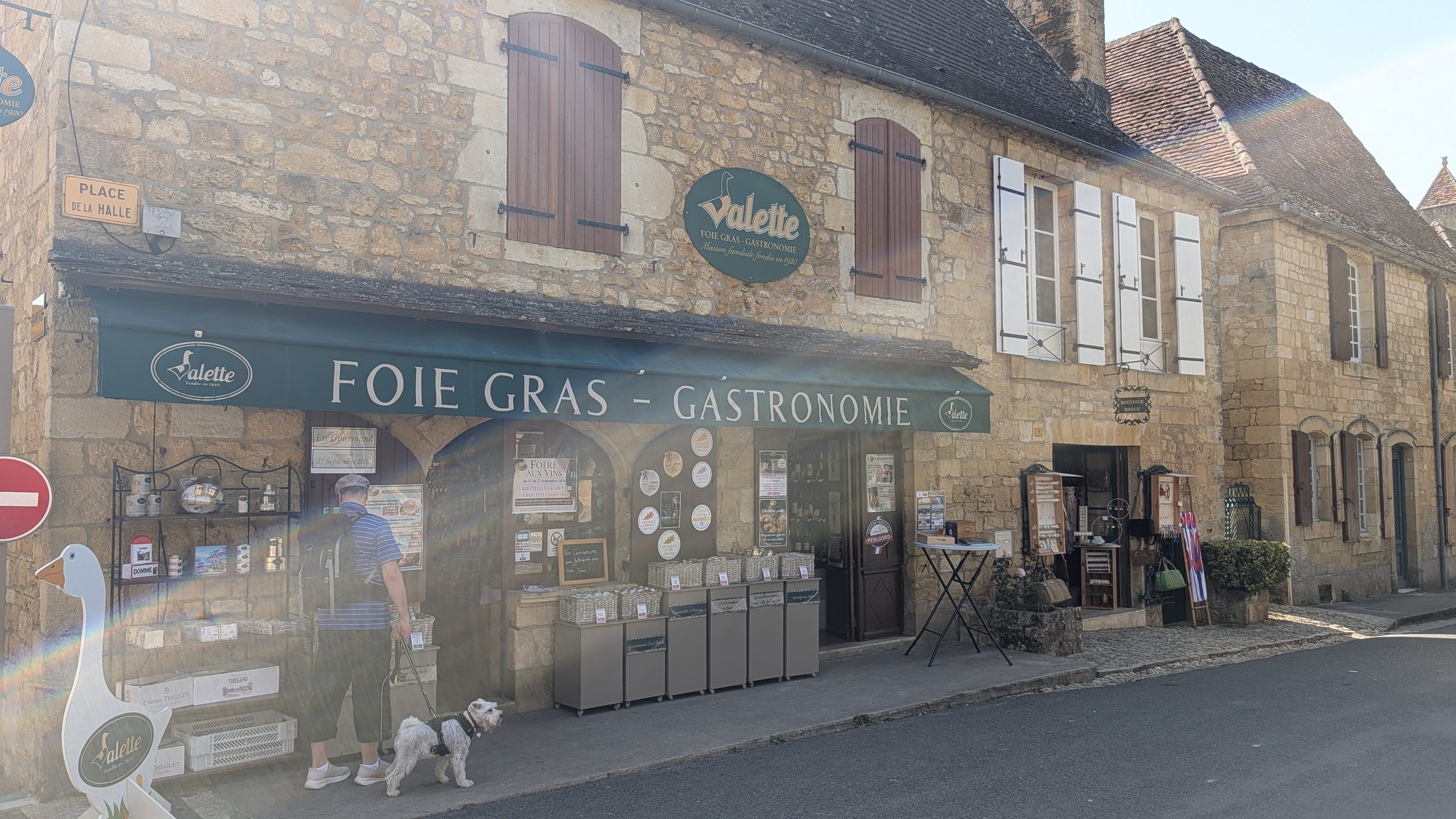
The Périgord is known for duck, black truffles, walnuts, cèpes and small goats’ cheeses, cooked simply and served with the red, white and sweet wines of Bergerac, Monbazillac and, across the border in the Lot, Cahors. On a walking or cycling holiday from April to October you will eat it at its seasonal peak: strawberries in spring, summer truffles and night markets in summer, and fresh walnuts and cèpes in the autumn.
By Cassie ·
The Périgord on a plate
Much of Périgord cooking began on the farm, and the cookery writer La Mazille brought it to a wider audience with La Bonne Cuisine du Périgord in 1929. Dordogne Experience is a family business, owned and run by Cassie, creating walking and cycling holidays in the Dordogne for over 40 years. Many of our hotels are small, family-run places with a good dinner, so this guide covers what you will meet at the table and how to eat well on the trail.


Signature dishes
Duck: confit, magret and foie gras
Confit de canard began as a way for farmers to preserve duck or goose: the legs are cooked slowly in their own fat for about three hours, then stored in it. It is often served with pommes sarladaises or cèpes.
Magret is the breast of a duck raised for foie gras. It became popular in the early 1970s and is usually simply grilled. You will also see gésiers (gizzards, often in salads) and cou farci, a stuffed duck neck.
Foie gras is the liver of ducks or geese fattened on maize, served cold as a terrine or mi-cuit, or pan-fried. Duck foie gras from the Périgord can carry an IGP label, which guarantees the birds were raised on a Périgord farm and prepared in the Périgord. If you would rather not eat it, there is almost always another choice.
Pommes de terre sarladaises
Named after Sarlat, these are thinly sliced raw potatoes cooked in goose or duck fat with garlic and parsley. They come with most regional main courses, especially confit and magret. Some restaurants add slices of truffle, though Saveur notes that truffle is not traditional to the dish.
Tourin and “faire chabrol”
Tourin (also spelled tourain) is the Périgord’s garlic soup, made with garlic, often onion, and goose fat or lard, thickened with egg and poured over slices of bread. It is traditionally served to newlyweds.
When you reach the last few spoonfuls, a Périgord custom is to faire chabrol (or chabrot): pour a splash of red wine into the bowl and drink the mixture straight from it. Today it is seen as an old country custom, though some people still do it for fun.
Enchaud and mique
Enchaud is a loin of pork cooked slowly with garlic in goose fat, a pork version of confit. It is most often eaten cold, in slices.
Mique is a large dumpling made from bread or flour, eggs and sometimes bacon, cooked in a broth of vegetables and meat. Older versions used maize flour. Leftovers are good fried in butter.
Truffles and cèpes on the plate
The simplest way to taste the black truffle is in an omelette aux truffes or scrambled eggs. Locals store a truffle with fresh eggs so they absorb its scent.
Sauce Périgueux, named after the Périgord’s capital, is a rich sauce of Madeira and chopped truffle, served with beef fillet, eggs or poultry, and classically with tournedos Rossini.
Cèpes (porcini) grow in oak and chestnut woods in summer and mostly in autumn. They are often pan-fried à la persillade, with garlic and parsley, in duck fat, or made into an omelette, soup or tart. Fresh cèpes appear from early September until about All Saints’ Day (1 November).
Salade périgourdine
The Périgord’s big salad is a meal in itself: green leaves with confit gizzards, slices of dried or smoked magret, walnuts and croutons, dressed with walnut oil and vinegar.
Walnut cake, walnut tart and flaugnarde
Gâteau aux noix is made with finely ground walnut kernels, sometimes flavoured with rum or vanilla. Tarte aux noix, a walnut tart, is just as common. Flaugnarde is a baked batter pudding from the Périgord and Limousin, related to clafoutis, made with eggs, flour, sugar and milk and pieces of apple, pear or plum.


Dishes to look for on a menu
| On the menu | What it is |
|---|---|
| Confit de canard | Duck leg slow-cooked and preserved in its own fat |
| Magret de canard | Duck breast, usually simply grilled |
| Pommes sarladaises | Sliced potatoes cooked in duck or goose fat with garlic and parsley |
| Tourin | Garlic soup with egg, poured over bread |
| Enchaud | Pork loin confit with garlic, usually served cold |
| Salade périgourdine | Salad with gizzards, dried magret, walnuts and walnut oil |
| Omelette aux cèpes or aux truffes | Omelette with wild cèpes or black truffle |
| Sauce Périgueux | Madeira and truffle sauce, often with beef |
| Cabécou or Rocamadour | Small goats’ cheese, often served warm on toast |
| Gâteau aux noix | Walnut cake |
| Flaugnarde | Baked batter pudding with apple, pear or plum |
Ingredients and labels
The black truffle
The Périgord black truffle, Tuber melanosporum, is known locally as the “black diamond”. It grows under truffle oaks, is found by trained dogs, and is a winter product: the season runs from about December to February, sometimes into March.
The famous truffle markets are all in winter. Sarlat sells truffles on Saturday mornings in season and holds its Fête de la Truffe in mid-January. Sainte-Alvère holds a controlled market on Monday mornings from late November to late February, where every truffle is inspected and graded. In the Lot, Lalbenque holds a wholesale truffle market on Tuesday afternoons in winter, listed as a Site Remarquable du Goût.
Our holidays run from April to October, so you will not see the winter markets. You may, however, meet the summer truffle, Tuber aestivum or Saint-Jean truffle: black outside, pale inside, milder, harvested from about May to September and eaten raw. Sainte-Alvère holds a summer truffle market from mid-June to mid-July, and Limogne-en-Quercy in the Lot has one on Sunday mornings from mid-June to mid-August.
In Sarlat, the Truffle Museum (Musée de la Truffe) at 9 Rue des Consuls is set in a building listed as a historic monument, with an immersive visit, workshops and tastings. It is included on Premium Périgord. Some truffle growers also open their truffières for guided visits.
Noix du Périgord
The walnuts of the Périgord have been protected since 2002, first as an AOC and since 2004 as an AOP, and walnut oil from the Périgord has had its own AOP since 2021. The walnut AOP covers 612 communes, mainly in the Dordogne, Lot, Corrèze and Charente, and four varieties: Franquette, Marbot, Grandjean and Corne.
The harvest runs from mid-September to the end of October, so an autumn holiday brings fresh walnuts. Walnut oil, pressed hot or cold, has a strong, toasty flavour and is used to dress salads.
Rocamadour and cabécou
Rocamadour is a small, flat disc of raw goats’ milk cheese, weighing about 35 g and roughly 6 cm across. It has been protected since 1996. It is made mainly in the Lot and named after the town of Rocamadour. Try it at room temperature, or warm on toast or in a salad.
Cabécou is the general name for these small, soft goats’ cheeses, usually under 40 g. Locals suggest a glass of Bergerac or Domme wine with it.
Strawberries, chestnuts, lamb and saffron
- Fraise du Périgord IGP. Périgord strawberries have had an IGP since 2004. They are picked from April to October, in varieties such as Gariguette, Mara des Bois and Charlotte, and Vergt, south of Périgueux, holds a strawberry festival in May.
- Chestnuts. Grown mainly in the Périgord Vert and the south of the Périgord Noir, and used for flour, cakes, cream and a chestnut liqueur.
- Agneau du Quercy IGP. Farm lamb from the Causse du Lot breed, raised in the Lot and neighbouring areas, including around Sarlat.
- Saffron. Grown in the Quercy and, on a small scale, in the Dordogne. It takes 150 to 200 hand-picked flowers to make about a gram.


Wines
Bergerac and its neighbours
The Bergerac vineyards lie along the Dordogne in the south-west of the department, around the town of Bergerac, in the Périgord Pourpre. The Pays de Bergerac tourist office counts 10 AOPs covering 17 wines: reds, rosés, dry whites, sweet whites and dessert wines.
Names to look for:
- Pécharmant: a red from near Bergerac that rewards some ageing.
- Monbazillac: the famous sweet white, from the left bank of the Dordogne directly across from Bergerac, an AOC since 1936. It is made only from grapes touched by noble rot, and the 16th-century Château de Monbazillac stands among the vines.
- Saussignac: a dessert wine from late-picked, very ripe grapes.
- Rosette: the smallest appellation, making sweet whites.
- Montravel: dry whites and reds; its neighbours Côtes de Montravel and Haut-Montravel make sweet whites.
- Côtes de Duras: just over the border in the Lot-et-Garonne, making reds, rosés and dry and sweet whites. It shares a wine route with Bergerac.
Cahors and the Quercy
Cahors is the red wine of the Lot valley, grown on terraces in the river’s meanders west of Cahors. It has been an AOC since 1971 and must be at least 70% Malbec, known locally as Côt or Auxerrois, with Merlot or Tannat making up the rest. Its deep colour earned it the name “black wine”, and in the Middle Ages it was shipped to England through Bordeaux.
Coteaux du Quercy, from the south of the Lot and north of the Tarn-et-Garonne, makes reds and rosés based on Cabernet Franc.
Small local wines on our routes
Two small vineyards sit right on our routes. Vin de Domme comes from the limestone slopes of the Céou valley below Domme. Abandoned after phylloxera and replanted a century later, it now has around 17 producers. In the Lot, the Coteaux de Glanes IGP covers seven communes around Bretenoux, on the Dordogne between Beaulieu-sur-Dordogne and Carennac, making red, rosé and white wines.
Which wines are close to which routes
Premium Périgord and Cycling in the Dordogne pass through Domme, home of Vin de Domme. France’s Most Beautiful Villages and Exploring Rocamadour are close to Coteaux de Glanes country, and Cahors is the Lot’s red. On every route, the Bergerac and Monbazillac vineyards lie further west.
Walnut wine and liqueurs
Vin de noix is a sweet aperitif made in June from green walnuts steeped in red wine with sugar and spices. Don’t confuse it with eau de noix, a stronger spirit made from green walnuts. Look out too for chestnut liqueur and truffle aperitifs.


Eating out
Lunch, dinner and closing days
- Lunch is usually from about 12 to 2pm, and kitchens are strict about service times. Arrive before 1pm to be safe.
- Dinner usually starts around 7 to 7.30pm.
- Expect closing days. In small towns, restaurants often close on Mondays, and on Sundays many serve lunch only. Some restaurants on our routes also close on other days. That is why France’s Most Beautiful Villages starts on set days only, and why a cycling holiday starting on a Sunday or Monday has one dinner fewer included (with the price reduced).
- Shops close at lunchtime too, often from 12 to 2pm, so buy picnic supplies in the morning. Some small villages have nowhere open at midday.
Menu du jour and formule
Many restaurants offer a menu du jour at lunchtime: a fixed-price menu, usually three courses with bread, sometimes with coffee or a small jug of wine included. The choice may be limited. A formule is a shorter version, such as starter and main or main and dessert, and a formule du marché is built around seasonal local produce.
Markets and night markets
Sarlat’s market fills the medieval town on Wednesday mornings and all day on Saturdays, with foie gras, duck, walnuts, honey, wine and, in season, cèpes and strawberries. Smaller markets on our Dordogne routes include Les Eyzies and Beynac (mid-June to mid-September) on Mondays, Castelnaud on Tuesdays, Montignac on Wednesdays, Domme on Thursdays, La Roque-Gageac on Fridays and Saint-Geniès on Sundays. Many village markets are seasonal. See our market days guide for more.
In summer, look out for night markets, the Marchés des Producteurs de Pays. Farmers cook what you choose on the spot, and everyone eats together at long tables in the village square. They are held in villages around Sarlat, and in the Lot there are summer evening markets at Carennac, Padirac and Souillac. Dates change each year, so check the local tourist office.
Fermes-auberges and farm visits
A ferme-auberge is a farm restaurant, run on a working farm and cooking mainly with its own produce. Book a table in advance. The label is used by networks such as Bienvenue à la ferme, run by France’s chambers of agriculture since 1988, which also lists farm shops, farm visits and producers’ markets.
Walnut and truffle visits
The Écomusée de la Noix at Castelnaud-la-Chapelle, at the foot of the Château de Castelnaud, sits in a 7-hectare organic walnut grove and explains walnut growing, with a miller showing how the oil is made. The stone-wheeled Moulin de Vielcroze nearby also presses walnut oil. Castelnaud is on Castles & Caves and Cycling in the Dordogne. For truffles, Sainte-Alvère, further west, has a truffle trail and a demonstration truffle farm. Check opening times on the official sites before you go.
Vegetarian and other dietary needs
Being honest: eating vegetarian in the Périgord can be harder than at home. Tourist areas cater better, but elsewhere it can be hit and miss, because so many local dishes are based on duck or pork, and cooking fat is often duck fat. Omelettes, salads with goats’ cheese and walnuts, and the cheese course are useful standbys. Tell us when you book and tell your hotels ahead of time, especially where dinner is included, so they can plan something for you. The Domme lunch platter on Premium Périgord can be made vegetarian on request. The same goes for allergies and other diets.


Which holidays go there

Premium Périgord
A Gourmet Journey
6 days · from £950 per person, sharing a double/twin room
6 days from £950, short walks of 4.6 to 14.1 km (2.9 to 8.8 miles) a day. Included: a Truffle Museum tour and tasting, a private wine tasting with paired dishes in a 15th-century chapel cellar in Sarlat, and a cheese and charcuterie platter for lunch in Domme. Also 7 and 8 days.

Castles & Caves of the Dordogne
8 days · from £995 per person, sharing a double/twin room
8 days from £995. Walk past Castelnaud, near the walnut museum, and end with a free day in Sarlat, with its Wednesday and Saturday markets.

Cycling in the Dordogne
8 days · from £1,250 per person, sharing a double/twin room
8 days from £1,250. Ride through Domme, Castelnaud, Les Eyzies, Montignac and Saint-Geniès, all with weekly markets, with a free day in Sarlat.

Exploring Rocamadour
8 days · from £975 per person, sharing a double/twin room
8 days from £975. Two nights in Rocamadour, home of the AOP goats’ cheese, finishing at Carennac.

France’s Most Beautiful Villages
8 days · from £965 per person, sharing a double/twin room
8 days from £965. Through Rocamadour cheese and Coteaux de Glanes country, via Carennac, Padirac and Castelnau.
Questions
What food is the Périgord famous for?
Duck (confit, magret and foie gras), black truffles, walnuts, cèpes and small goats’ cheeses such as Rocamadour, with pommes sarladaises on the side.
Can I see truffles on a summer holiday?
Not the black truffle, which is a winter product. You can visit the Truffle Museum in Sarlat and taste summer truffles, sold from about May to September.
What wine is the Périgord known for?
Bergerac reds, rosés and whites, Pécharmant, and the sweet white Monbazillac. Cahors, the Malbec “black wine”, comes from the neighbouring Lot.
Are restaurants in the Dordogne closed on Mondays?
Often, in small towns and villages. Many also serve only lunch on Sundays, so check before you set out.
Is it easy to eat vegetarian in the Dordogne?
It can be harder than at home. Tell us when you book and tell your hotels in advance so they can plan.
More to read
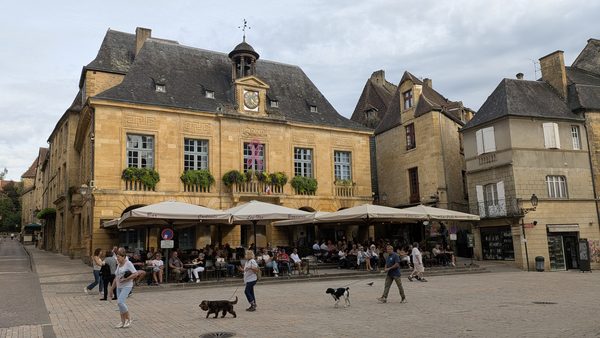
Sarlat-la-Canéda: a guide to the old town, markets and festivals
Sarlat, capital of the Périgord Noir: a walk through the old town, the Wednesday and Saturday markets, the glass lift, festivals and quiet evenings.
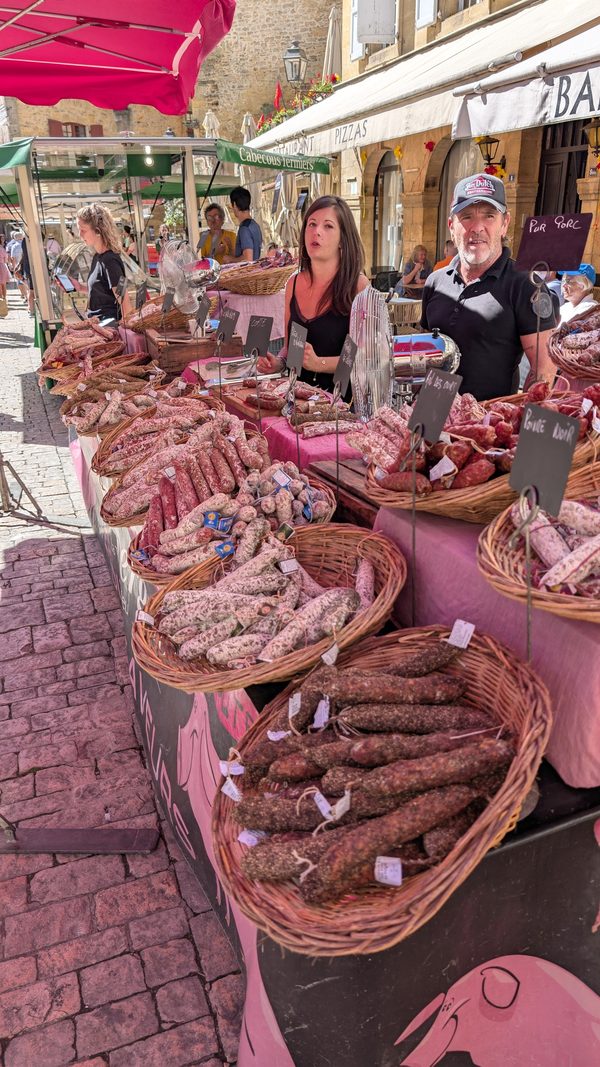
Market days in the Dordogne on our routes
Market days in the towns on our Dordogne walking and cycling routes, from Sarlat’s Wednesday and Saturday markets to the village markets along the way.
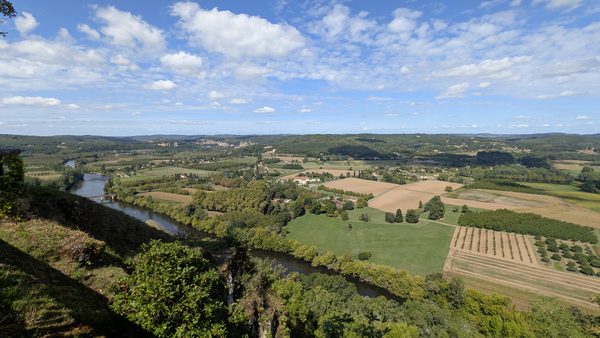
The Périgord explained: Noir, Vert, Blanc and Pourpre
The Périgord is the old name for the Dordogne department, split into four colours: Noir, Vert, Blanc and Pourpre. Here’s what each is known for.

Hidden gems of the Dordogne
Cassie’s hidden gems of the Dordogne: the Château de Castelnau, Beaulieu from across the river, Domme’s boutique shops and the Rocamadour circular walk.

When to go walking or cycling in the Dordogne
When to go walking or cycling in the Dordogne and the Ardèche, month by month from April to October, with the weather and the markets along the way.
Sources
- Le Routard, Périgord gastronomy (confit, enchaud, magret, foie gras, tourin, mique, sauce Périgueux, cèpes, walnut varieties, chestnuts, saffron, Bergerac and Pécharmant, vin de noix and liqueurs) (routard.com)
- Wikipedia (French), Cuisine périgourdine (La Mazille 1929, mique, chabrol, flaugnarde, vin de noix and eau de noix, strawberries since the 1960s) (fr.wikipedia.org)
- Lascaux Dordogne tourist office, culinary tradition (pommes sarladaises with garlic and parsley, enchaud, cèpe omelette) (lascaux-dordogne.com)
- Saveur, Sarlat-style potatoes (goose fat, garlic, parsley; truffle not traditional) (saveur.com)
- Love French Food, tourin (garlic soup, chabrol, served to newlyweds) (lovefrenchfood.com)
- Facaros and Pauls, French Food Decoder, tourin (garlic, duck or goose fat, bread) (facarospauls.com)
- Wikipedia, Chabrot (wine added to the last of the soup, drunk from the bowl) (en.wikipedia.org)
- La langue française, faire chabrol (Limousin and Périgord) (lalanguefrancaise.com)
- Wikipedia, Sauce Périgueux (Madeira and truffle, tournedos Rossini) (en.wikipedia.org)
- Wikipedia (French), Salade périgourdine (ingredients) (fr.wikipedia.org)
- Wikipedia (French), Flaugnarde (Périgord and Limousin, ingredients) (fr.wikipedia.org)
- Dordogne Périgord Tourisme, cèpes (season, woods, persillade, cèpe markets) (dordogne-perigord-tourisme.fr)
- Dordogne Périgord Tourisme, foie gras IGP Périgord (traceability, duck, goose to follow) (dordogne-perigord-tourisme.fr)
- Dordogne Périgord Tourisme, gastronomy overview (dordogne-perigord-tourisme.fr)
- Sarlat tourist office, the black Périgord truffle (species, December to February, Saturday market, mid-January Fête, summer truffle, eggs) (en.sarlat-tourisme.com)
- Dordogne Périgord Tourisme, the Périgord truffle (species, seasons incl. summer truffle May to August, controlled markets, truffle hunts, uses) (dordogne-perigord-tourisme.fr)
- Grand Périgueux tourist office, Sainte-Alvère (Monday winter market, summer market mid-June to mid-July, truffle trail and demonstration truffière) (tourisme-grandperigueux.fr)
- Tourisme Occitanie, the truffle (Lalbenque Tuesday market, Site Remarquable du Goût, Limogne summer market, Saint-Jean truffle May to September) (tourisme-occitanie.com)
- Sarlat tourist office, Musée de la Truffe (9 Rue des Consuls, historic monument building, immersive visit) (en.sarlat-tourisme.com)
- Meininger, Trüffelmuseum Sarlat (tastings and workshops) (meininger.de)
- INAO, Noix du Périgord specification (AOC 2002, varieties, area) (extranet.inao.gouv.fr)
- Dordogne Périgord Tourisme, Noix du Périgord (AOP 2004, walnut oil AOP 2021, 612 communes, varieties, harvest, Écomusée de la Noix, Moulin de Vielcroze, gâteau aux noix, vin de noix) (dordogne-perigord-tourisme.fr)
- Sarlat tourist office, walnuts of the Périgord (varieties, uses, walnut liqueur) (en.sarlat-tourisme.com)
- Sarlat tourist office, the gourmet Périgord (cabécou with Bergerac or Domme wine) (en.sarlat-tourisme.com)
- Brive Tourisme, Rocamadour cheese (35 g, 60 mm, PDO 1996, Lot, serving) (brive-tourisme.com)
- Wikipedia, Rocamadour cheese (raw goats’ milk, AOC 1996, former name) (en.wikipedia.org)
- Wikipedia, Cabécou (size, goats’ milk) (en.wikipedia.org)
- France.fr, the strawberry of the Périgord (IGP 2004, April to October, varieties, Vergt festival in May) (france.fr)
- Wikipedia (French), Agneau du Quercy (IGP, breed, 70 days, area) (fr.wikipedia.org)
- Pays de Bergerac tourist office, appellations (10 AOPs for 17 wines, styles) (pays-bergerac-tourisme.com)
- Wikipedia, Bergerac wine (grapes, Pécharmant, Rosette, Saussignac, Montravel) (en.wikipedia.org)
- Wikipedia, Monbazillac AOC (1936, grapes, noble rot, across the river from Bergerac) (en.wikipedia.org)
- France Today, 12 foodie experiences in the Dordogne (16th-century Château de Monbazillac) (francetoday.com)
- Wikipedia, Côtes de Duras (Lot-et-Garonne, AOC 1937, styles) (en.wikipedia.org)
- Dordogne Périgord Tourisme, wines (Bergerac and Duras, Vin de Domme, Route des Vins de Bergerac & Duras) (dordogne-perigord-tourisme.fr)
- Wikipedia (French), Périgord IGP (Vin de Domme geographical unit) (fr.wikipedia.org)
- Wikipedia, Cahors wine (AOC 1971, 70% Malbec, terraces, villages, black wine) (en.wikipedia.org)
- Wikipedia (French), Coteaux du Quercy (area, red and rosé, Cabernet Franc) (fr.wikipedia.org)
- Wikipedia (French), Coteaux de Glanes (seven communes around Bretenoux, colours) (fr.wikipedia.org)
- Sarlat tourist office, a gourmet escapade through the Sarlat market (market days, covered market, night markets) (en.sarlat-tourisme.com)
- Dordogne Périgord Tourisme, markets of Sarlat and the Périgord Noir (village market days, seasons) (dordogne-perigord-tourisme.fr)
- Lot Tourisme, markets of the Lot 2024 (summer evening markets at Carennac, Padirac and Souillac; truffle markets) (tourisme-lot.com)
- Dordogne Périgord Tourisme, fermes-auberges (farm restaurants, own produce, book a table) (dordogne-perigord-tourisme.fr)
- Wikipedia (French), Bienvenue à la ferme (chambers of agriculture, 1988, fermes-auberges, producers’ markets) (fr.wikipedia.org)
- Complete France, guide to eating out in France (menu du jour, formule, formule du marché, vegetarian options) (completefrance.com)
- The Local France, what time do the French eat (lunch 12 to 2pm, dinner from 7 to 7.30pm, Monday closing, Sunday lunch) (thelocal.fr)
- FrenchEntrée, opening hours in France (strict service hours, arrive before 1pm, shop lunch closing) (frenchentree.com)
- Holiday details: Dordogne Experience holiday pages (/premium-perigord, /vezere-valley, /plus-beaux-villages, /rocamadour, /cycling-dordogne)