
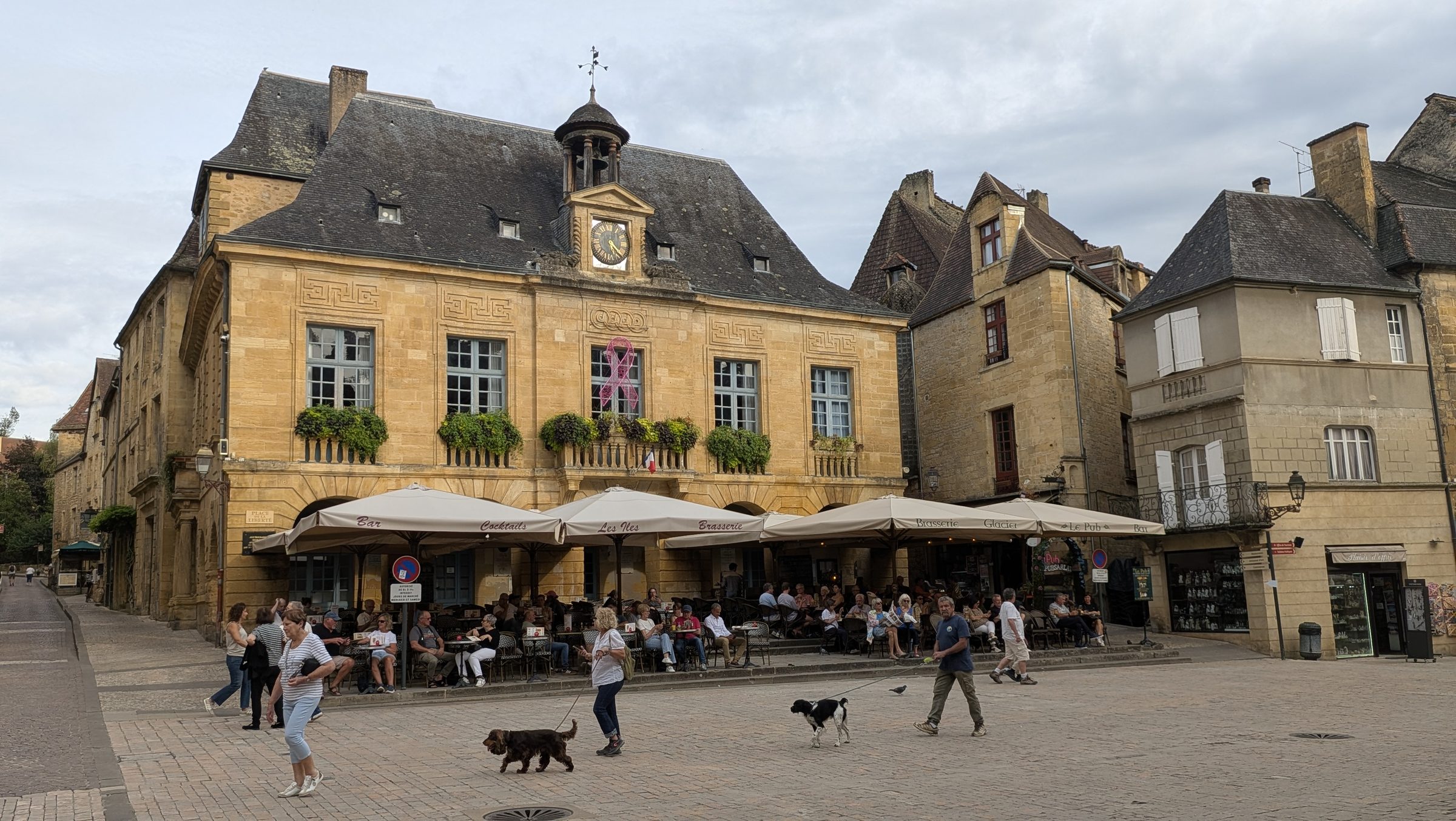
Sarlat-la-Canéda is the medieval and Renaissance capital of the Périgord Noir, a small town of golden limestone and stone-slab roofs whose old centre was saved and restored under the Malraux law of 1962. Come for the Wednesday or Saturday market, walk its lanes on foot, and stay for the evening, when the day visitors leave and the gas lamps come on.
By Cassie ·
What Sarlat is
Sarlat grew up around a Benedictine abbey founded in the late 8th century. In 1317 the pope made the abbey the seat of a new bishopric, and the town prospered through the 16th, 17th and 18th centuries as merchants, magistrates and noble families built themselves fine stone houses. Then it slipped into a long quiet spell, which is partly why so much survived. Today about 8,800 people live here.
The look is what stays with you: honey-coloured limestone, steep roofs of lauzes (heavy, flat limestone slabs) and lanes that turn into small squares. The old town packs more than 60 protected monuments into about 11 hectares, and the Michelin Green Guide gives it three stars. Sarlat has been a Ville d’Art et d’Histoire since 2002.
Saved by the Malraux law
On 4 August 1962, the law named after André Malraux, then Minister of Culture, created France’s secteurs sauvegardés, protected historic districts with public money for restoration. Sarlat’s protected sector was created on 27 August 1964, among the first alongside Lyon, Avignon, Troyes and the Marais in Paris. Restoration began in 1966 with the Hôtel de Montméjat on Rue Jean-Jacques Rousseau, the first operational restoration block in France.
The rules still apply. Any work that changes a building in the protected sector needs approval from the state’s heritage architect, the Architecte des Bâtiments de France, checked against a detailed conservation plan.
A film star of a town
Those preserved streets have made Sarlat a favourite with film crews since the silent era. Le Capitaine Fracasse (1929) was one of the first films shot on location here. Others include Ridley Scott’s The Duellists, Robert Hossein’s Les Misérables, Bertrand Tavernier’s Revenge of the Musketeers, Andy Tennant’s Ever After, and Luc Besson’s The Messenger: The Story of Joan of Arc. Spotting a scene as you walk is part of the fun.


A walk through the old town
The old town is compact and made for walking, and it rewards a slow morning. The Rue de la République, which locals call la Traverse, runs straight through the middle. It was cut between 1837 and 1865 to bring light and air into the crowded medieval town, and it splits Sarlat into an eastern and a western half.
Place de la Liberté and the Sainte-Marie church
Start in the Place de la Liberté, the main square, with the town hall and café terraces. At its top end stands the former church of Sainte-Marie, rebuilt in the 14th and 15th centuries and later used as a post office. Jean Nouvel, the architect who grew up in Sarlat, converted it into the covered market, finished in 2000. You go in through steel doors about 15 metres high, their dark grey said to echo the lauze roofs. Inside are stalls of cheese, fruit, vegetables, cakes and other local food.
In the old bell tower, a glass-walled panoramic lift designed by Nouvel has operated since 2012. It rises 35 metres, and a guide points out the landmarks from the top: the market square, the Lantern of the Dead and the former bishop’s palace, now the tourist office. The trip takes about 12 minutes. Go on a clear day, and take sunglasses: it can be surprisingly hot above the rooftops. Opening dates and prices change, so check the tourist office site.
Place du Marché aux Oies
Just north of the Place de la Liberté, the goose market square was a trading place in the 13th-century merchant quarter. Three bronze geese stand in the middle, a gift to the town from a local foie gras house. On the square is the Manoir de Gisson, two buildings joined by a hexagonal stair tower under a seven-sided lauze roof. It is currently open to visitors from spring to early January, with rooms on the daily life of Sarlat’s nobility and an exhibition on the history of justice. Check the official site for current hours.
Rue de la Salamandre and Rue des Consuls
The salamander is one of Sarlat’s emblems (the tourist office notes that the town’s “S” later became one). On Rue de la Salamandre, look for the Hôtel de Grézel, with a 15th-century stair tower and a flamboyant Gothic doorway. Nearby on Rue des Consuls is the Hôtel Plamon, bought in 1473 by Guillaume Plamon, and the Musée de la Truffe at number 9, in a listed 15th-century building (see below).
The Présidial
The Présidial was Sarlat’s royal court of justice. It was created in 1552 and the building dates from around 1620. In the 18th century it gained a grand staircase lit from above by a lanternon, the small lantern-shaped turret that makes it easy to spot. It now houses a restaurant.
The cathedral, the Maison de La Boétie and the Lanterne des Morts
The Cathédrale Saint-Sacerdos grew out of the old abbey church. Its great choir dates from the early 16th century and its nave was finished in 1685, which explains the mix of Romanesque and Gothic. The organ was installed in 1752 and restored in 2005.
Opposite, on the Place du Peyrou, is the richly carved Renaissance house built between 1520 and 1525 by the father of Étienne de La Boétie. La Boétie was born here in 1530 and wrote the Discourse on Voluntary Servitude, an essay against tyranny. He was the close friend Montaigne wrote about in his essay on friendship. The house is usually closed, apart from exhibitions and heritage days, but the façade is the thing to see.
Walk round the cathedral to the Jardin des Enfeus, a quiet terraced garden where burial niches were cut into the wall from the 14th century. Above it stands the Lanterne des Morts, a round stone tower of about 1170. It is linked by legend to Saint Bernard, who passed through Sarlat in 1147 and is said to have healed the sick with blessed bread. Nobody knows for certain what the tower was for.
Hôtel de Maleville
Back towards the Traverse, the Hôtel de Maleville (also called the Hôtel de Vienne) joins three earlier houses around a central stair tower. It is named after Jean de Vienne, who became a superintendent of finances under Henri IV. Look for the three carved medallions over the classical doorway, said to show Henri IV and a royal lady, with an “M” for the Maleville family in the centre.
The Quartier Ouest
Cross the Traverse into the western half, where tourists thin out fast. Here you’ll find half-timbered houses, steep lanes and a stretch of the old ramparts visible from Rue Jean-Jacques Rousseau. On the same street is the Chapelle des Pénitents Blancs, built between 1618 and 1626 as the church of the Récollet friars and taken over by the White Penitents in 1804.


Markets
Sarlat has been a market town since the Middle Ages, and the market is still the heartbeat of the week.
Wednesday and Saturday
The traditional market fills the old town on Wednesday mornings and all day on Saturday, all year round. Saturday is the big one. Look for walnuts, foie gras, confit and magret of duck, cèpes, honey, wine, and in season Périgord strawberries and chestnuts. Arrive by about 10am, before the crowds build towards lunchtime. There is also an organic market at the Place de la Poste on Thursday afternoons. See our guide to market days in the Dordogne for markets in other towns on our routes.
The covered market
The covered market in the old Sainte-Marie church sells local produce under one roof. In July and August, organ concerts are held there as part of a summer series.
Winter truffle and foie gras markets
In winter, roughly December to February, a truffle market and a marché au gras (fattened duck and goose) take place on Saturday mornings. Our holidays run from April to October, so you won’t see them, but the Truffle Museum and a tasting give you a taste of the season (see below).

Festivals through the year
Dates change every year, so check the tourist office before you plan around one.
- Fête de la Truffe (mid-January): a weekend of truffle markets, truffle-dog demonstrations on the Place du Peyrou, cookery lessons and tastings.
- Fest’Oie (early March): a weekend celebrating the goose, with a market, goose parades through the old town and cookery workshops.
- Journées du Terroir (Ascension weekend, May or early June): a celebration of local produce.
- Festival des Jeux du Théâtre (late July to early August): open-air plays in the Place de la Liberté, the Jardin des Enfeus and the courtyard of the old Sainte-Claire abbey.
- Festival du Film de Sarlat (November): a film festival held every November since 1991, with previews and hundreds of school students taking part.
- Christmas market (December): chalets of local producers and craftspeople on the Place de la Grande Rigaudie, with the old streets lit up.

Evenings and quiet times
Sarlat is very busy in summer, especially July and August, and on Saturdays in the morning. The trick is to be there when the crowds aren’t. Early morning, before the shops open, the lanes are much quieter, and the stone glows in the low sun.
Evenings are magical. Once the day visitors leave, the lanes empty and the street lamps come on. These are real gas lamps, reinstalled in the early 1990s, and their soft light on the golden stone is something you remember. If you can, visit in May, June or September, when it is quieter and the weather is still good for walking. See when to go.
Walks and rides from Sarlat
The Voie Verte, a car-free greenway on a former railway line, starts at the Madrazès roundabout in Sarlat and runs south-east towards Cazoulès past Carsac and Groléjac. It is tarmac all the way and reserved for walkers and cyclists. On Premium Périgord and Castles & Caves, your route notes also include an 8.3 km (5.2 miles) circular walk in the hills around the town, with views back over the roofs and spires.

Practical tips
- Train: Sarlat has a railway station, with trains to Bergerac and Bordeaux. See getting there.
- No car needed: the old town is compact, and our holidays bring you in on foot or by bike, with your luggage moved for you. If you need a taxi, ask your hotel to book one.
- Busiest times: July, August and Saturday mornings. Book early for May, June and September, as small hotels fill first.

Sarlat in one day
A suggested route, on foot, for a market day.
- 9 to 10am: coffee on the Place de la Liberté as the stalls set up, then the market before the lunchtime crowds.
- Late morning: the covered market in Sainte-Marie and the panoramic lift, while the light is good.
- Lunch: try pommes sarladaises, potatoes sliced thin and cooked in duck or goose fat, named after the town.
- Early afternoon: the Place du Marché aux Oies and its geese, the Manoir de Gisson, then Rue de la Salamandre and Rue des Consuls.
- Mid-afternoon: the Présidial, the cathedral, the Maison de La Boétie, the Jardin des Enfeus and the Lanterne des Morts.
- Late afternoon: cross the Traverse to the Quartier Ouest and the Chapelle des Pénitents Blancs.
- Evening: dinner, then a last walk through the lanes by gaslight.
Most of our holidays can start almost any day, so ask us to time your Sarlat day for a Wednesday or Saturday.
Which holidays go there

Premium Périgord
A Gourmet Journey
6 days · from £950 per person, sharing a double/twin room
6 days from £950, also 7 and 8 days. Walk into Sarlat on the Voie Verte for two nights. A tour and tasting at the Truffle Museum is included, plus an 8.3 km (5.2 miles) circular walk with views over the roofs and, at 6pm, a private wine tasting with small paired dishes in the Cave Chapelle XV at Aux 3 Sens, a 15th-century cellar that was once a chapel.

Castles & Caves of the Dordogne
8 days · from £995 per person, sharing a double/twin room
8 days from £995, also 9 and 10 days. Walk from Les Eyzies via Beynac, Castelnaud and Vitrac, finishing with two nights in Sarlat and a free day: the market on Wednesdays and Saturdays, the glass lift, or an optional 8.3 km (5.2 miles) circular walk.

Cycling in the Dordogne
8 days · from £1,250 per person, sharing a double/twin room
8 days from £1,250. Ride along the Dordogne from Souillac to Sarlat on day 2, with a free day on day 3 to explore the town or ride out to Domme and La Roque-Gageac.
Dordogne Experience is a family business, owned and run by Cassie, creating walking and cycling holidays in the Dordogne for over 40 years.
Questions
What days is Sarlat market?
Wednesday morning and all day Saturday, all year. Saturday is the main market. There is also an organic market on Thursday afternoons.
Is one day enough for Sarlat?
One day covers the market, the lift, the cathedral and the old lanes. Staying the night lets you see it in the evening, when it is much quieter.
What is the glass lift in Sarlat?
A glass-walled panoramic lift in the bell tower of the old Sainte-Marie church, designed by Jean Nouvel. It rises 35 metres, and a guide points out the sights from the top.
Why is Sarlat so well preserved?
It became one of France’s first protected historic districts under the Malraux law of 1962, and building work in the old town is still strictly controlled.
Which films were shot in Sarlat?
They include The Duellists, Les Misérables (1982), Ever After and The Messenger: The Story of Joan of Arc.
Can I see the truffle market on a summer holiday?
No, the truffle markets are held in winter. On Premium Périgord, a tour and tasting at Sarlat’s Truffle Museum is included.
When is Sarlat busiest?
July, August and Saturday mornings. Early mornings and evenings are quieter all year.
Can I get to Sarlat by train?
Yes. Sarlat has a railway station with trains to Bergerac and Bordeaux. See getting there.
More to read
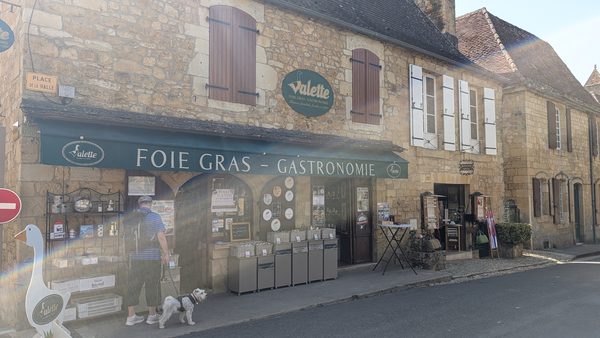
Food and wine of the Périgord
Truffles, walnuts, duck, Rocamadour cheese and the wines of Bergerac, Monbazillac and Cahors, with dishes to look for and tips for eating out.
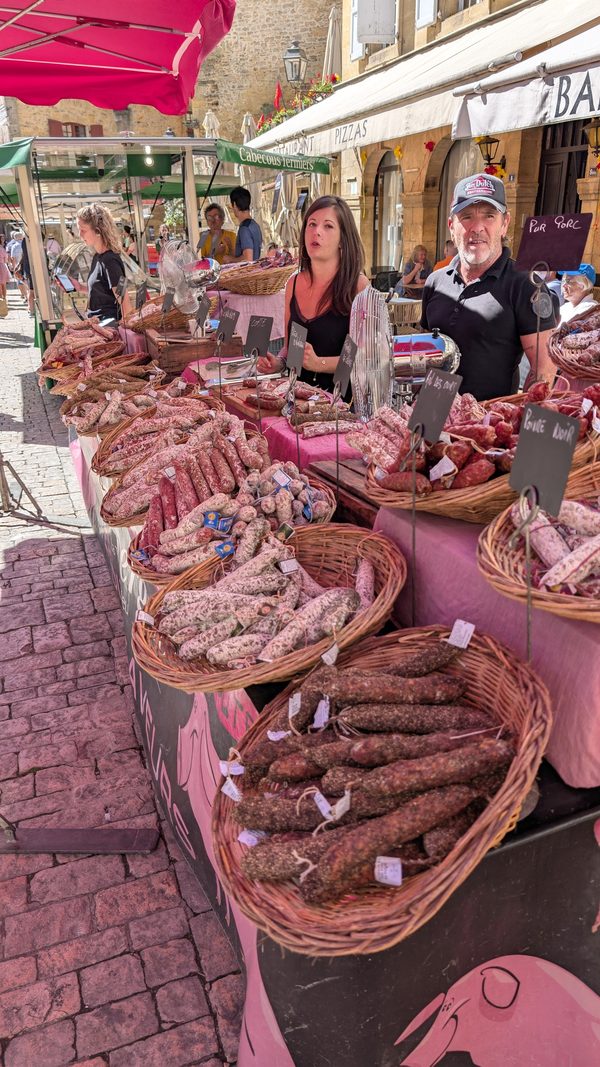
Market days in the Dordogne on our routes
Market days in the towns on our Dordogne walking and cycling routes, from Sarlat’s Wednesday and Saturday markets to the village markets along the way.

Hidden gems of the Dordogne
Cassie’s hidden gems of the Dordogne: the Château de Castelnau, Beaulieu from across the river, Domme’s boutique shops and the Rocamadour circular walk.
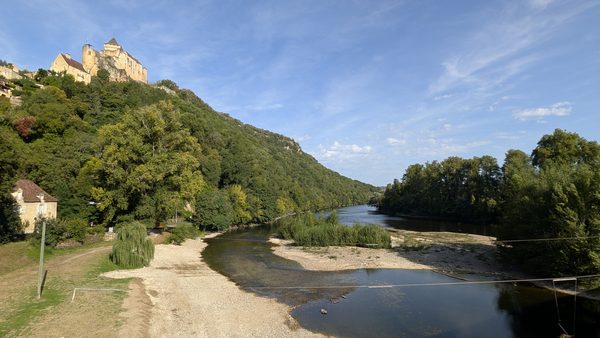
Castles of the Dordogne: which to visit
Beynac, Castelnaud, Milandes, Montfort, Marqueyssac, Castelnau-Bretenoux and Fénelon: what each is like and which of our holidays pass it.

When to go walking or cycling in the Dordogne
When to go walking or cycling in the Dordogne and the Ardèche, month by month from April to October, with the weather and the markets along the way.
Sources
- Sarlat tourist office, history from the origins to the 14th century (abbey, Saint Bernard 1147, Lanterne des Morts, Quartier Ouest ramparts, the salamander) (en.sarlat-tourisme.com)
- Sarlat tourist office, history from the 17th century to the present (Malraux law of 4 August 1962, la Traverse) (en.sarlat-tourisme.com)
- Sarlat tourist office, Les clefs de Sarlat (PDF, in French; dates for the Traverse, Présidial, Hôtel de Maleville, Rue de la Salamandre, Maison de La Boétie, Lanterne des Morts, Jardin des Enfeus, Pénitents Blancs, Hôtel Plamon, Sainte-Marie, cathedral, gas lighting) (sarlat-tourisme.com)
- Sarlat tourist office, panoramic lift (35 m (about 100 ft), about 12 minutes, guide, tips) (en.sarlat-tourisme.com)
- Sarlat tourist office, market (Wednesday and Saturday, organic market, covered market, winter truffle and fat markets) (en.sarlat-tourisme.com)
- Sarlat tourist office, films shot in Sarlat (en.sarlat-tourisme.com)
- Sarlat tourist office, Truffle Fête (mid-January) (en.sarlat-tourisme.com)
- Sarlat tourist office, theatre festival (late July to early August, venues) (en.sarlat-tourisme.com)
- Sarlat tourist office, Manoir de Gisson (en.sarlat-tourisme.com)
- Sarlat tourist office, Musée de la Truffe (en.sarlat-tourisme.com)
- Musée de la Truffe, official site (15th-century listed building, guided or self-guided visits) (museedelatruffe.com)
- Sarlat tourist office, the greenway by bike (en.sarlat-tourisme.com)
- Sites et Cités Remarquables, Sarlat: les 50 ans de la loi Malraux (PDF, in French; 27 August 1964, Lyon, Avignon, Troyes, the Marais, 1966 first block, controls today) (sites-cites.fr)
- Dordogne Périgord Tourisme, Sarlat Ville d’Art et d’Histoire (June 2002, over 60 listed monuments in 11 ha, Michelin three stars, organ concerts, La Boétie house) (dordogne-perigord-tourisme.fr)
- Dordogne Périgord Tourisme, Sarlat (lift by Jean Nouvel) (dordogne-perigord-tourisme.fr)
- Dordogne Périgord Tourisme, Pays de Sarlat (lauze roofs, festival calendar including Fest’Oie, Journées du Terroir and film festival) (dordogne-perigord-tourisme.fr)
- Dordogne Périgord Tourisme, Fest’Oie (dordogne-perigord-tourisme.fr)
- Dordogne Périgord Tourisme, Sarlat Christmas market (dordogne-perigord-tourisme.fr)
- Dordogne Périgord Tourisme, Voie Verte Sarlat to Cazoulès (former railway, tarmac, walkers and cyclists) (dordogne-perigord-tourisme.fr)
- Dordogne Périgord Tourisme, markets of Sarlat and the Périgord Noir (dordogne-perigord-tourisme.fr)
- Ville de Sarlat, opening of the truffle market (PDF, in French) (sarlat.fr)
- CNC, 5 films et séries tournés à Sarlat et dans sa région (Le Capitaine Fracasse, The Duellists, Les Misérables) (cnc.fr)
- CNC, Festival du Film de Sarlat 2025 (since 1991, school students) (cnc.fr)
- Le Routard, Sarlat, le bonheur est dans le Périgord (busy summers, gas lamps at night, Jean Nouvel grew up in Sarlat) (routard.com)
- Wikipedia (French), Sarlat-la-Canéda (population, bronze geese, lift since 2012, railway) (fr.wikipedia.org)
- Wikipedia (English), Sarlat-la-Canéda (films, trains to Bergerac and Bordeaux) (en.wikipedia.org)
- Wikipedia (English), Étienne de La Boétie (en.wikipedia.org)
- Le Routard, Périgord gastronomy (pommes sarladaises) (routard.com)
- Rachel Phipps, Exploring Sarlat during the Saturday morning market (arrive about 10am) (rachelphipps.com)