
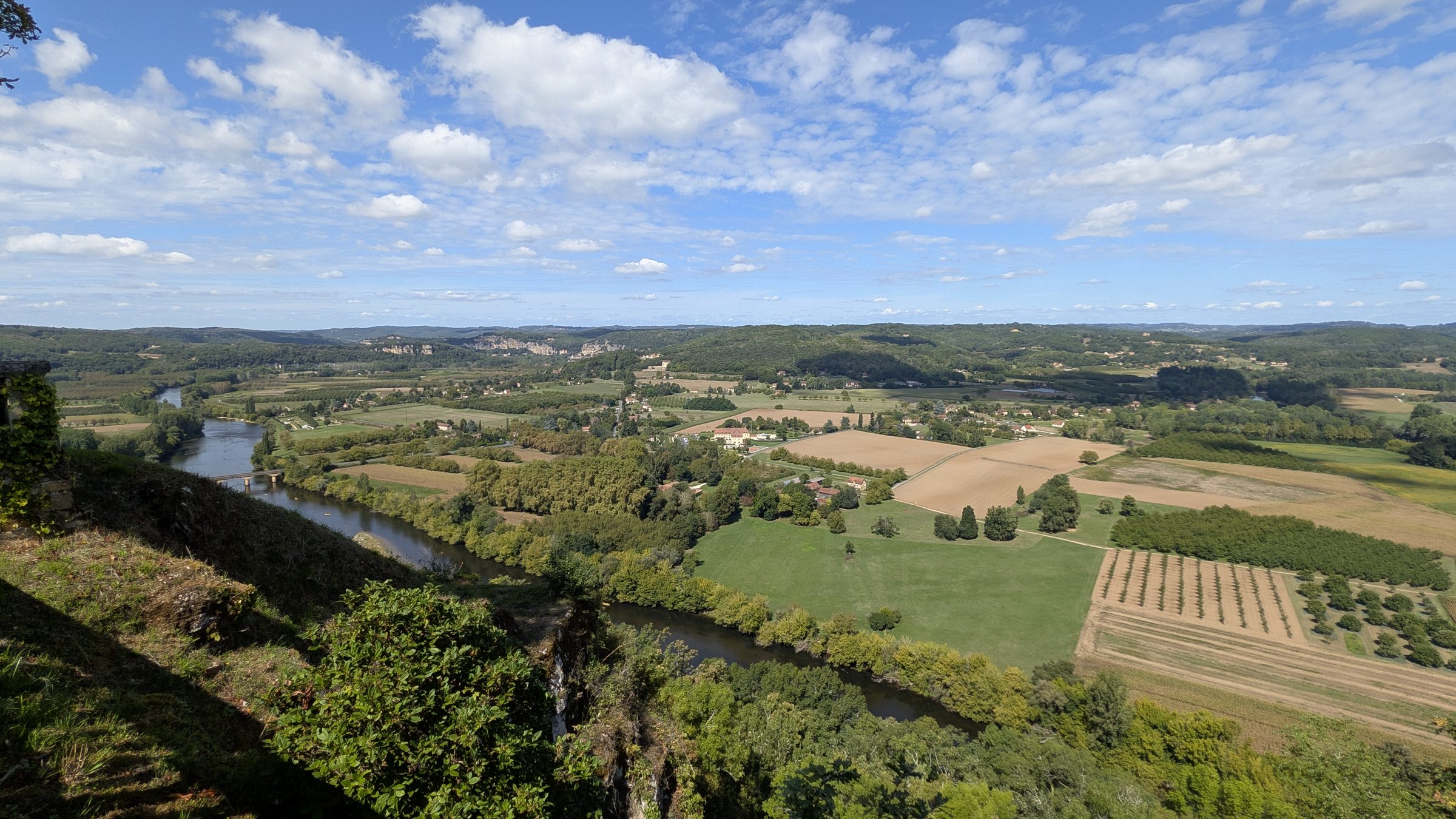
The Périgord is the historic name for the area now covered by the Dordogne department, and it is divided into four “colours”: Périgord Noir, Vert, Blanc and Pourpre. Most of our walking and cycling holidays are in the Périgord Noir, in the south-east, while two of them carry on east into the Lot and the Corrèze.
By Cassie ·
Périgord and Dordogne: the same place?
Very nearly. The Dordogne department was created in 1790, during the French Revolution, from the old province of Périgord, and the two cover roughly the same ground: the new department followed the old borders closely, taking in only small pieces of the neighbouring provinces. Its prefecture, or county town, is Périgueux, and it sits in the Nouvelle-Aquitaine region.
That’s why you’ll hear both names used for the same place. Locals often say Périgord, the official name is Dordogne, and the departmental tourist board uses both: Dordogne-Périgord.

The four Périgords
The colours are a handy way of describing four quite different landscapes within the one department. They describe the landscape rather than official boundaries, so you’ll find the borders drawn slightly differently from map to map.
Périgord Noir (black), in the south-east. Centred on Sarlat, with Les Eyzies, Montignac and the Vézère valley. This is the land of prehistoric caves and rock shelters, clifftop castles along the Dordogne river and villages of golden stone such as Domme, Beynac, Castelnaud and La Roque-Gageac. It is the oldest of the four names. Sources explain the “black” in slightly different ways: most point to its dark woods of evergreen oak, some add the darker, richer soil or the old charcoal burners’ pits. It is often linked to the black truffle, but the woods, not the truffle, are the usual explanation.
Périgord Vert (green), in the north. Around Nontron and Brantôme: green, well-watered country crossed by streams, with part of the Périgord-Limousin Regional Natural Park and Brantôme’s abbey on its river.
Périgord Blanc (white), in the centre. Along the Isle valley around Périgueux, the department’s capital, with its Roman remains and domed, Byzantine-style cathedral of Saint-Front. The white refers to the pale limestone of its plateaus and buildings. There is truffle country here too, around Sorges, which has a truffle museum.
Périgord Pourpre (purple), in the south-west. Around Bergerac, named for its wine. Think vineyards, the sweet wines of Monbazillac and fortified medieval towns called bastides, such as Monpazier and Eymet. It is the newest of the four names, coined in the late 20th century.


Where the Lot and the Corrèze fit in
Head east from Sarlat and you soon leave the Dordogne department.
The Lot lies to the south-east, in the Occitanie region, with Cahors as its prefecture. It was created in 1790 from the old province of Quercy, so you’ll see “Quercy” on wine labels, menus and signposts. Rocamadour, the Gouffre de Padirac, Loubressac, Carennac and Autoire are all in the Lot, as is Souillac.
The Corrèze lies to the east and north-east, in Nouvelle-Aquitaine like the Dordogne. Its prefecture is Tulle and its largest town is Brive-la-Gaillarde. The south of the Corrèze, part of the old Bas-Limousin, has the red sandstone village of Collonges-la-Rouge, hilltop Turenne and Curemonte, and Beaulieu-sur-Dordogne on the river.


The Dordogne river and the Dordogne department
The river came first, and the department is named after it. But the river is far longer than the department: it rises on the Puy de Sancy in the Auvergne mountains and runs about 483 km (300 miles) through six departments, Puy-de-Dôme, Cantal, Corrèze, Lot, Dordogne and Gironde, before joining the Garonne north of Bordeaux to form the Gironde estuary.
So when you walk along the Dordogne at Beaulieu or Carennac, you are by the river, but not in the Dordogne department. Since 2012 the whole river basin has been a UNESCO Biosphere Reserve.

At a glance
| Area | Where | Main towns | Known for | Our holidays |
|---|---|---|---|---|
| Périgord Noir | South-east of the Dordogne department | Sarlat, Les Eyzies, Montignac, Domme | Prehistoric caves, castles, golden-stone villages | Castles & Caves, Premium Périgord, Cycling in the Dordogne |
| Périgord Vert | North | Nontron, Brantôme | Green valleys, streams, regional natural park | None |
| Périgord Blanc | Centre | Périgueux | Limestone plateaus, Roman remains, cathedral | None |
| Périgord Pourpre | South-west | Bergerac, Monpazier, Eymet | Vineyards, Monbazillac, bastide towns | None |
| The Lot (Quercy) | South-east, Occitanie region | Cahors, Souillac, Rocamadour | Pilgrimage town of Rocamadour, the Padirac chasm, Cahors wine | Exploring Rocamadour, France’s Most Beautiful Villages |
| The Corrèze | East, Nouvelle-Aquitaine region | Brive, Tulle | Red sandstone villages, hilltop Turenne | France’s Most Beautiful Villages |
Which holidays go there

Castles & Caves of the Dordogne
8 days · from £995 per person, sharing a double/twin room
Périgord Noir: from Les Eyzies in the Vézère valley to Sarlat, via Beynac, Castelnaud, Domme and Vitrac. 8 days from £995.

Premium Périgord
A Gourmet Journey
6 days · from £950 per person, sharing a double/twin room
Périgord Noir: short walks from Le Port de Domme to La Roque-Gageac and Domme, then two nights in Sarlat. 6 days from £950.

Cycling in the Dordogne
8 days · from £1,250 per person, sharing a double/twin room
Mostly Périgord Noir: circular from Souillac, just over the border in the Lot, via Sarlat, Beynac, Les Eyzies and Montignac. 8 days from £1,250.

France’s Most Beautiful Villages
8 days · from £965 per person, sharing a double/twin room
The Corrèze and the Lot: from Sarrazac, on the Lot side of the border near Brive, through Turenne, Collonges-la-Rouge, Curemonte and Beaulieu in the Corrèze, then Carennac, Padirac and Loubressac in the Lot. 8 days from £965.

Exploring Rocamadour
8 days · from £975 per person, sharing a double/twin room
The Lot: Souillac, St Sozy, Rocamadour, Loubressac and Carennac. 8 days from £975.
Questions
Is the Périgord the same as the Dordogne?
Almost. The Dordogne department was created in 1790 from the old province of Périgord and covers roughly the same area. Locals and the tourist board use both names.
What are the four Périgords?
Périgord Noir around Sarlat, Périgord Vert in the north, Périgord Blanc around Périgueux and Périgord Pourpre around Bergerac.
Why is it called the Périgord Noir?
Most sources put it down to its dark evergreen oak woods, and some to its darker soil. It is often linked to the black truffle, but that is not the usual explanation.
Is Rocamadour in the Dordogne?
No. Rocamadour is in the Lot department, next door to the Dordogne, in the old province of Quercy.
Which Périgord are your holidays in?
Castles & Caves, Premium Périgord and the cycling holiday are mostly in the Périgord Noir. Our other two walking holidays are in the Lot and the Corrèze.
More to read
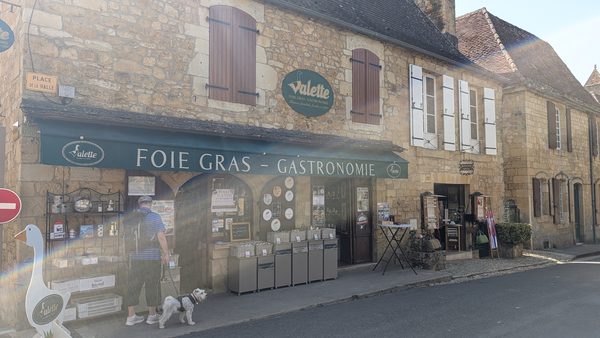
Food and wine of the Périgord
Truffles, walnuts, duck, Rocamadour cheese and the wines of Bergerac, Monbazillac and Cahors, with dishes to look for and tips for eating out.

Why visit the Dordogne?
Golden-stone villages, clifftop castles, prehistoric caves, the river and its markets: why the Dordogne is so special, and how to see it on foot or by bike.
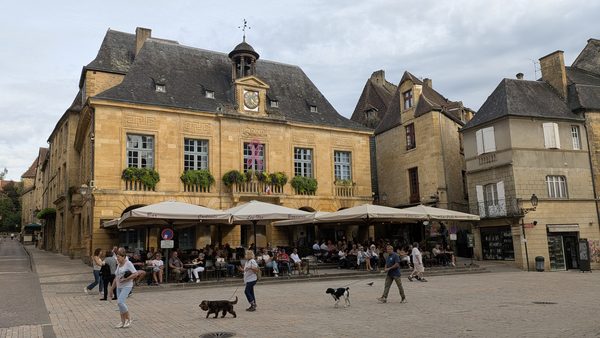
Sarlat-la-Canéda: a guide to the old town, markets and festivals
Sarlat, capital of the Périgord Noir: a walk through the old town, the Wednesday and Saturday markets, the glass lift, festivals and quiet evenings.

The most beautiful villages in the Dordogne
Golden-stone villages under clifftop castles, a whole village built of red sandstone, and a pilgrimage town stacked up a cliff: the villages our holidays are built around.

When to go walking or cycling in the Dordogne
When to go walking or cycling in the Dordogne and the Ardèche, month by month from April to October, with the weather and the markets along the way.
Sources
- Wikipedia, Dordogne (department): created 4 March 1790 from the province of Périgord, prefecture Périgueux, Nouvelle-Aquitaine, the four Périgords, Noir named from its oak and pine forests (en.wikipedia.org)
- Lascaux Dordogne tourist office, a trip idea for every Périgord (towns and character of each colour, Noir from oaks and charcoal pits, Pourpre name from the 1990s, Blanc from limestone, Sorges truffle eco-museum) (lascaux-dordogne.com)
- Wikipedia, Périgord noir (towns, name from dark evergreen oaks, not the truffle) (en.wikipedia.org)
- Wikipedia, Dordogne (river): source on the Puy de Sancy, 483 km (300 miles), six departments, Gironde estuary, UNESCO Biosphere Reserve 2012 (en.wikipedia.org)
- Wikipedia, Lot (department): Occitanie, prefecture Cahors, created from Quercy (en.wikipedia.org)
- Wikipedia, Quercy: former province covering most of the Lot, capital Cahors (en.wikipedia.org)
- Wikipedia, Corrèze: Nouvelle-Aquitaine, prefecture Tulle, Brive the largest town, Bas-Limousin (en.wikipedia.org)
- Wikipedia, Turenne (Corrèze) (en.wikipedia.org)
- Wikipedia, Souillac (Lot) (en.wikipedia.org)
- Wikipedia, Sarrazac (Lot), now part of Cressensac-Sarrazac (en.wikipedia.org)
- TourMaG, four Plus Beaux Villages in the Lot (Martel, Carennac, Loubressac, Autoire) (tourmag.com)
- Brive Tourisme, the Most Beautiful Villages of France around Brive (Collonges-la-Rouge, Curemonte and Beaulieu in the Corrèze; Rocamadour, Carennac and Loubressac in the Lot) (brive-tourisme.com)
- Dordogne-Périgord tourist board (name in use) (dordogne-perigord-tourisme.fr)
- Wikipedia (French), Périgord (Noir the oldest name, holm oaks and richer soil; Blanc pale limestone soil; Vert oak, chestnut, meadows, granite; Pourpre dating from 1980, vine leaves, Bergeracois formerly in the Blanc; department took small parts of neighbouring provinces; the colours are a tourist classification) (fr.wikipedia.org)
- Wikipedia, Périgueux (Roman remains of Vesunna, Cathedral of Saint-Front) (en.wikipedia.org)
- Wikipedia (French), Dordogne (fleuve) (483 km (300 miles), Puy de Sancy, six departments, Bec d’Ambès, whole basin a UNESCO Biosphere Reserve on 11 July 2012) (fr.wikipedia.org)
- Wikipedia (French), Quercy (Lot created from Quercy in 1790, Cahors the capital, Rocamadour the great Quercy pilgrimage site) (fr.wikipedia.org)
- Wikipedia, Cressensac-Sarrazac (commune nouvelle in the Lot, formed 1 January 2019) (en.wikipedia.org)
- French Ministry of the Interior, BANATIC, commune of Cressensac-Sarrazac (INSEE 46083, department 46 Lot, postcode 46600) (banatic.interieur.gouv.fr)
- Holiday details: Dordogne Experience holiday pages