
Why visit the Dordogne?
Is the Dordogne worth visiting? Yes. In a small area you’ll find golden-stone villages beneath clifftop castles, prehistoric caves, a slow green river and the food the Périgord is known for. Here’s what makes it special, and how to see it.
By Cassie ·
At a glance
Villages
Golden-stone villages beneath clifftop castles
Prehistory
The Vézère valley’s prehistoric sites and decorated caves have been a UNESCO World Heritage Site since 1979.
The river
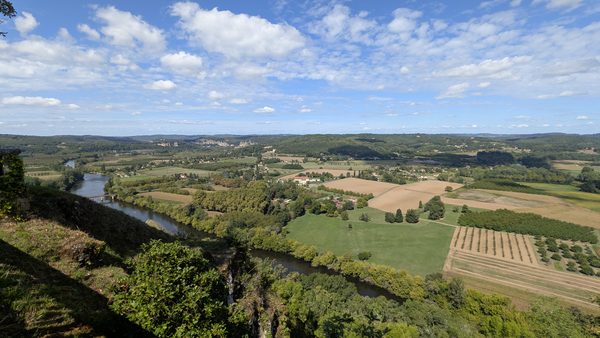
A slow green river
Food
The food the Périgord is known for
When to go
The season for walking and cycling runs from April to October.
Villages that look the part
Many of the villages here are members of Les Plus Beaux Villages de France, the association of France’s most beautiful villages: Beynac and Castelnaud facing each other across the river, Domme on its clifftop, La Roque-Gageac tucked beneath its cliff, Collonges-la-Rouge built entirely of red sandstone, and hilltop Turenne and Curemonte.
Our guide to the most beautiful villages in the Dordogne describes each one, and which of our holidays visits it.

Castles on every skyline
The river was once a frontier, and the castles show it: Beynac and Castelnaud on their cliffs, the Château de Montfort above a bend in the river, the rediscovered Château de Commarque in the woods, and the red Château de Castelnau further up the valley.

Prehistory you can walk into
The Vézère valley’s prehistoric sites and decorated caves have been a UNESCO World Heritage Site since 1979. In Les Eyzies, tucked beneath limestone cliffs, Cro-Magnon people lived some 15,000 years ago, and the National Museum of Prehistory tells their story.

A place of pilgrimage
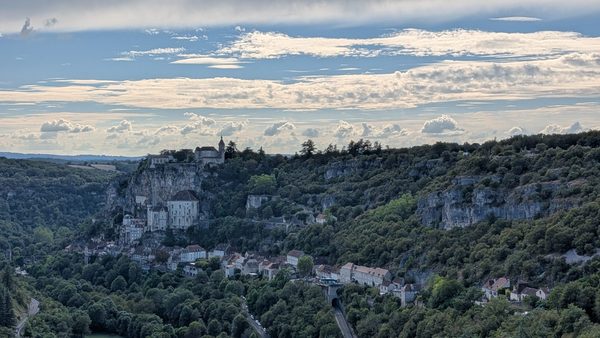
Rocamadour has been a major pilgrimage site since the Middle Ages. Rocamadour’s Basilica of Saint-Sauveur and the Crypt of Saint-Amadour are part of the UNESCO World Heritage listing “Routes of Santiago de Compostela in France”, and its houses and sanctuaries cling to the cliff above the Alzou gorge.

The river and the valleys
The Dordogne river and its tributaries wind through limestone valleys, past riverside villages such as Carennac and Beaulieu-sur-Dordogne, with quiet lanes, woodland paths and riverside cycle paths between them. Further east, the Lot brings Rocamadour, stacked up its cliff above the Alzou gorge.

Food and markets
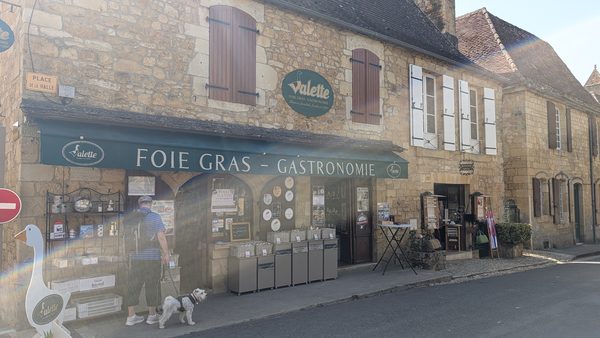
The Périgord is known for its food: walnuts, truffles, duck and the local cheeses and wines. Market days are an event: Sarlat’s big market fills the old town on Saturdays, with a smaller one on Wednesday mornings, Domme’s is on Thursday mornings and Souillac’s on Friday mornings.

When to go
The season for walking and cycling runs from April to October, and May and September are the months our guests choose most. Our month-by-month guide has more.

Getting there
It’s easier to reach than it looks. Most long-haul flights land at Paris Charles de Gaulle, with connecting flights to Bordeaux or Toulouse, and Bergerac and Brive have smaller airports. By train, Paris Austerlitz to Brive-la-Gaillarde takes about 4½ to 5 hours. Our Getting there page has the details for the start of every holiday.

How to see it
On foot or by bike, from one village to the next, with your luggage moved for you: see our self-guided walking holidays in the Dordogne and our self-guided cycling holidays in the Dordogne. For castles and caves, try Castles & Caves of the Dordogne; for the villages, France’s Most Beautiful Villages; by bike, Cycling in the Dordogne. And for the places Cassie loves most, read her hidden gems of the Dordogne.

More to read

The most beautiful villages in the Dordogne
Golden-stone villages under clifftop castles, a whole village built of red sandstone, and a pilgrimage town stacked up a cliff: the villages our holidays are built around.
The Périgord explained: Noir, Vert, Blanc and Pourpre
The Périgord is the historic name for most of the Dordogne department in south-west France, split into four colours: Noir, Vert, Blanc and Pourpre.
Food and wine of the Périgord
Truffles, walnuts, duck, Rocamadour cheese and the wines of Bergerac, Monbazillac and Cahors, with dishes to look for and tips for eating out.

When to go walking or cycling in the Dordogne
When to go walking or cycling in the Dordogne and the Ardèche, month by month from April to October, with the weather and the markets along the way.
Exploring Rocamadour
A self-guided walking tour to Rocamadour, UNESCO-listed on the Routes of Santiago de Compostela in France, then Padirac. Start any day. 8 days from £975.
Plan your visit
Tell us when you’d like to travel and how you like to walk or ride. We reply within 24 hours, usually much sooner.

Premium Périgord
A Gourmet Journey
4.6 to 15.1 km (2.9 to 9.4 miles) a day · Easy to moderate
6 days · from £950 per person, sharing a double/twin room

Castles & Caves of the Dordogne
12.8 to 16.8 km (8 to 10 miles) a day · Moderate
8 days · from £995 per person, sharing a double/twin room

France’s Most Beautiful VillagesLes Plus Beaux Villages de France
15.5 to 23 km (10 to 14 miles) a day · Moderate
8 days · from £965 per person, sharing a double/twin room

Exploring Rocamadour
11.2 to 20.1 km (7 to 12 miles) a day · Moderate
8 days · from £975 per person, sharing a double/twin room

Ardèche Adventure
13 to 23.2 km (8 to 14 miles) a day · Challenging
8 days · from £985 per person, sharing a double/twin room

Cycling in the Dordogne
23 to 47 km (14 to 29 miles) a day · Moderate
8 days · from £1,250 per person, sharing a double/twin room