
Each of our holidays links a string of villages, castles, caves and gardens that you reach on foot or by bike, and this guide goes through them stop by stop, in the order you meet them. For each one you’ll find a few lines on why it’s worth pausing, and which day of the holiday it falls on.
Dordogne Experience is a family business, owned and run by Cassie, creating walking and cycling holidays in the Dordogne for over 40 years. Entrance fees aren’t included on our holidays, and opening times and prices change every year, so check each site’s official website before you go.
By Cassie ·
Castles & Caves of the Dordogne (8 days)


Les Eyzies (days 1 and 2)
Les Eyzies sits on the Vézère beneath overhanging limestone cliffs and is known as the capital of prehistory. The Vézère valley’s prehistoric sites and decorated caves have been a UNESCO World Heritage Site since 1979, and the Abri de Cro-Magnon in the village is where the first remains of Homo sapiens in Europe were found, in 1868. Day 2 is an easy 12.8 km (8 miles) circular walk with views of the cliffs, leaving time for the sights below.
The National Museum of Prehistory (day 2)
The museum began when the schoolteacher and archaeologist Denis Peyrony bought the ruins of the Château des Eyzies to house his finds, and it opened in 1923. Its collections cover more than 400,000 years of human presence, from stone tools to the Venus of Laussel, a female figure carved in limestone. The tourist board suggests allowing at least two hours.
Font-de-Gaume (day 2)
Font-de-Gaume is where Denis Peyrony identified the first polychrome cave paintings found in France, and you can still see the originals. It holds about 230 figures from around 14,000 BC, 84 of them bison, along with mammoths, reindeer and horses. Visitor numbers are strictly limited to protect the paintings, so book online well ahead.
Abri Pataud (day 2)
This rock shelter, owned by the Muséum national d’Histoire naturelle since 1957, shows about 15,000 years of prehistory in its layers, from around 35,000 to 20,000 years ago. A small museum under the rock displays finds including a woman carved in relief. At the time of writing the Muséum’s website listed the site as closed, so check before you plan around it.
Grotte du Grand Roc (day 2)
Discovered in 1924 and opened in 1927, the Grand Roc is a cave of crystal formations rather than paintings, with stalactites, stalagmites and delicate calcite growths. The local tourist office describes it as the only cave with concretions in the Vézère valley. It shares its cliff with the prehistoric shelter of Laugerie-Basse.
Grotte de Saint-Cirq (day 2 detour)
In the Roc de Saint-Cirq, between Les Eyzies and Le Bugue, this small cave is engraved with horses, bison and a rare complete human figure, which gives it its other name, the Grotte du Sorcier. The State bought it in November 2024 to pass to the Centre des monuments nationaux, so check whether it’s open before you go.
Château de Commarque (day 3)
On the walk from Les Eyzies to Boyer (16.8 km (10 miles)), Commarque rises from woods in the little Beune valley, with a prehistoric cave beneath it. It was founded in the 12th century and abandoned in the 18th, until Hubert de Commarque bought the site in 1972; restoration has continued since 1994. Climb the keep for the view.
Boyer to Beynac (day 4)
Day 4 is 17.8 km (11 miles) through shaded woods and fields from your quiet night near Boyer, ending at the Dordogne.
Beynac and its château (days 4 and 5)
Beynac is one of the Plus Beaux Villages de France, with lauze-roofed houses climbing to a château set more than 150 metres above the river. Building began in the 12th century; the tourist board links the castle to Richard the Lionheart and lists a 13th-century kitchen, the hall of the Estates of the Périgord baronies and a keep with views all round. Allow about an hour and a half to two hours.
Saint-Vincent-de-Cosse (night 4)
A small riverside village a few kilometres from Beynac, with narrow lanes, open-air washhouses and dry stone walls. The Château de Monrecour, with its Renaissance details, stands at the village entrance, and the 15th-century Château de Panassou is nearby. Its old church, Saint-Vincent-le-Salvadou, is Romanesque, from the 12th century.
The gardens of Marqueyssac (day 5)
At Vézac, Marqueyssac’s romantic gardens were laid out in the early 19th century by Julien de Cerval. More than 150,000 hand-clipped box plants line over 6 km (3.7 miles) of paths, ending at a belvedere above the river with views to Beynac, Castelnaud and La Roque-Gageac. On some summer evenings the gardens are lit by candles; check the official site for dates.
Château de Castelnaud (day 5)
Across the river from its old rival Beynac, Castelnaud was rebuilt in the early 13th century and restored from the 1960s. It is now a museum of medieval warfare, with about 300 weapons and suits of armour and full-size working replicas of siege engines. Castelnaud-la-Chapelle, the village below, is also one of the Plus Beaux Villages.
Vitrac (night 5)
Vitrac, about 7 km (4.3 miles) south of Sarlat, is three hamlets in one: the riverside port, where you can hire a canoe, the village centre with its 12th-century church of Saint-Martin, and Montfort. Day 5 is 13.8 km (8.6 miles) from Beynac.
Château de Montfort (day 6)
On the 16.2 km (10 miles) walk to Sarlat you pass beneath Montfort, on a cliff above an almost circular loop of the river, the Cingle de Montfort. Simon de Montfort destroyed the castle in the early 13th century, and it has been rebuilt several times. It is a private home, so you admire it from below.
Sarlat (days 6 and 7)
Sarlat, capital of the Périgord Noir and a Ville d’Art et d’Histoire, is a medieval town of golden stone. See the 12th-century cathedral of Saint-Sacerdos, the 16th-century house of the writer Étienne de La Boétie, and the covered market in the former Sainte-Marie church, designed by Jean Nouvel, whose glass lift rises up the bell tower for a view over the roofs. The traditional market runs on Wednesday mornings and all day Saturday.
Premium Périgord (6 days)


Le Port de Domme (days 1 to 4)
Your first three nights are at the 4★ Hôtel Le Périgord, in a tree-lined park at the foot of the Domme hillside, close to the river. Your arrival taxi from Sarlat is included, and the walks to La Roque-Gageac and Domme start from the door.
La Roque-Gageac (day 2)
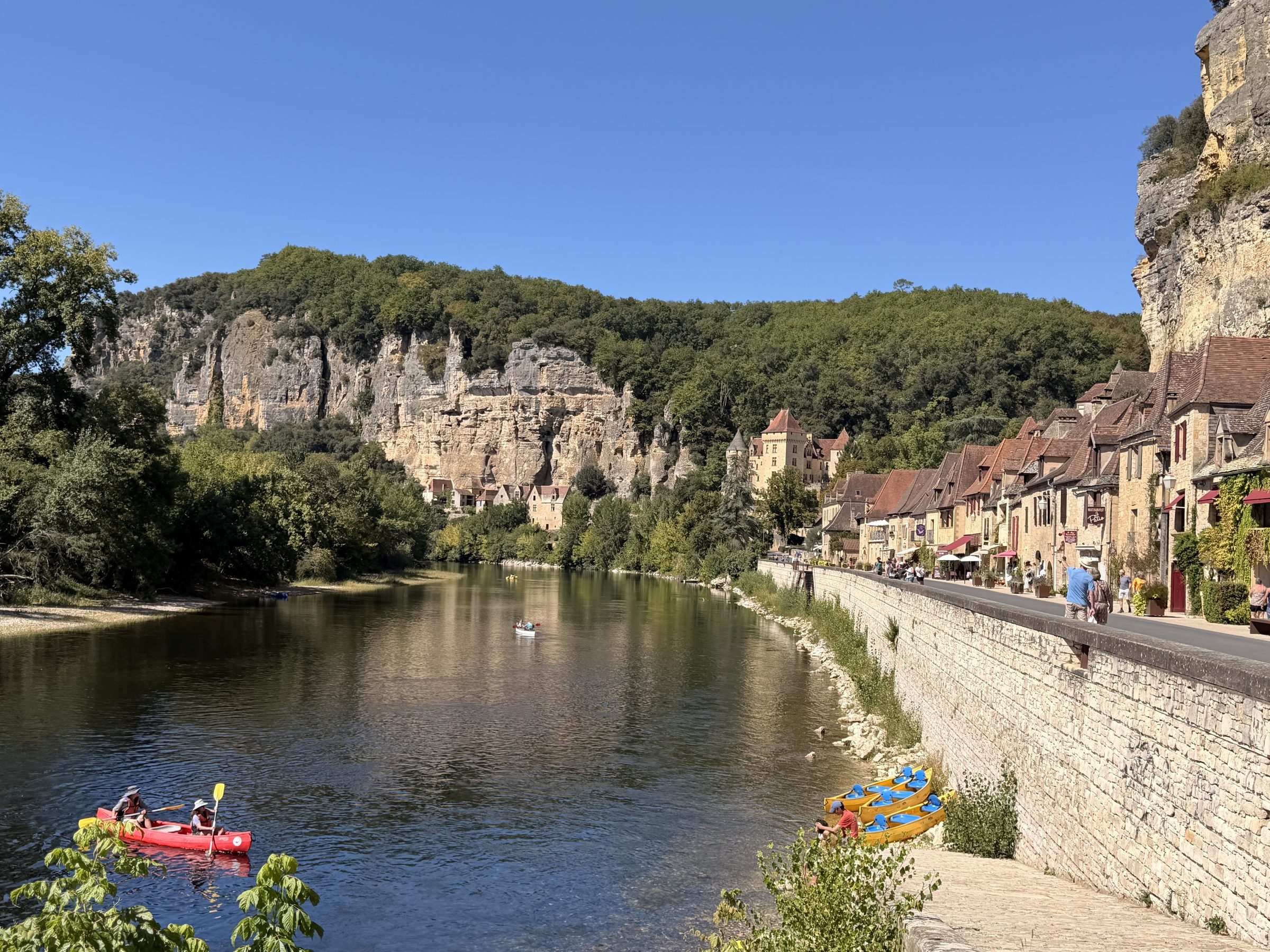
On the 7.4 km (4.6 miles) circular walk you come down to La Roque-Gageac, its golden houses pressed between a south-facing cliff and the river, one of the Plus Beaux Villages. Steps cut into the rock climb to its troglodyte fort, set in the cliff above the roofs, and the sheltered setting lets palms, bamboo and banana plants grow in its exotic garden. Marqueyssac (see Castles & Caves) is a short walk on.
A gabare on the river (day 2)
Gabares are the long, flat-bottomed boats that carried timber, barrel staves, walnut oil and wine down the Dordogne to Bordeaux. Today’s trips glide downstream with the current and return by motor, with a commentary on the river’s history, villages and castles. The tourist board says trips run between 1 April and 1 November and stop when the river is in flood.
Domme (day 3)
Domme is a bastide founded in 1281 by King Philip III, set on a clifftop known as la Barre and one of the Plus Beaux Villages. From the Esplanade de la Barre you look over the valley to Montfort, La Roque-Gageac, Beynac and Marqueyssac. Lunch today is an included tasting platter, and you can walk back the short way (4.6 km (2.9 miles)) or the long way through Vitrac (10.7 km (6.6 miles)).
The cave under the market hall (day 3)
Beneath Domme’s 17th-century market hall is the Grotte de Domme, discovered in 1912, with about 450 metres of galleries of stalactites, stalagmites and translucent draperies. At the end of the visit a panoramic lift carries you up the cliff face, with views over the valley, back to the village.
The Porte des Tours and the Templar graffiti (day 3)
Domme’s walls have three gates, and the two towers of the Porte des Tours were used as a prison for about 70 Knights Templar from 1307 to 1318. The prisoners carved graffiti into the walls, which is still there. Ask at the tourist office about visiting.
Vitrac and Montfort (days 3 and 4)
The long way back from Domme on day 3 follows the river through Vitrac, and on day 4 (14.1 km (8.8 miles)) farm lanes take you past the Château de Montfort. See Castles & Caves for both.
The Voie Verte into Sarlat (day 4)
The last stretch into Sarlat follows the Voie Verte, a greenway of over 30 km (19 miles) laid on an old railway line between Sarlat and Cazoulès. It is fully surfaced and reserved for walkers and cyclists, so you arrive in town away from traffic.
Sarlat (days 4 and 5)
Two nights in Sarlat (see Castles & Caves), with an 8.3 km (5.2 miles) loop on day 5 for views over the roofs and spires. Your Truffle Museum tour and tasting is in the old town, in a building listed as a historic monument, and on day 5 a private wine tasting is held in a 15th-century cellar that was once a chapel.
France’s Most Beautiful Villages (8 days)


Sarrazac (day 1)
Sarrazac is a quiet village in the Lot, on the edge of the Corrèze, and since 1 January 2019 it has been part of the commune of Cressensac-Sarrazac. It’s a peaceful start in open countryside, with a pool at your first hotel.
Turenne (day 2)
Turenne was the capital of a powerful viscounty spanning the Limousin, Périgord and Quercy, which until the 18th century minted its own coins and raised its own taxes and army. Climb the Tour de César for a 360° view, and walk the cobbled streets lined with turreted mansions. It’s your lunch stop on the 17.9 km (11 miles) walk to Meyssac.
Collonges-la-Rouge (day 2)
Collonges is built entirely of red sandstone, and in 1982 its former mayor, Charles Ceyrac, founded the Plus Beaux Villages de France association here. It grew up around a priory, flourished under the viscounts of Turenne, and is nicknamed the village of 25 towers, with 26 buildings listed as historic monuments. It has been a stop on the Way of St James for centuries.
Meyssac (night 2)
Meyssac is built of the same red sandstone as Collonges, from a local geological fault. Its 18th-century grain hall stands on great red sandstone pillars beside the church of Saint-Vincent, which was rebuilt and fortified in the 15th and 16th centuries. Markets are held on Tuesday and Friday mornings.
Curemonte (day 3)
Day 3 is the longest walk, 23 km (14 miles), and passes through Curemonte, on a ridge above the Sourdoire and Maumont valleys. The village has three castles, an 11th-century church at Saint-Hilaire de la Combe and the 12th-century church of Saint-Barthélemy. The writer Colette took refuge here in 1940 with her daughter, who owned two of the castles.
Beaulieu-sur-Dordogne (days 3 and 4)
The day ends down an old cobbled mule track into Beaulieu, a medieval town on the river and one of the more recent Plus Beaux Villages. Its abbey church of Saint-Pierre has a carved Romanesque tympanum of about 1130, showing the Last Judgement, which the Corrèze tourist board compares with the portal at Moissac. Look for the Chapelle des Pénitents by the water and the House of Adam and Eve in the old quarter; day 4 is a rest day, with an optional 14.6 km (9.1 miles) walk.
Carennac (day 5)
After 19.4 km (12 miles) of woods and wide views you cross the Dordogne to Carennac, a Plus Beau Village in the Lot that grew around an 11th-century Cluniac priory. The church of Saint-Pierre has a Romanesque tympanum, carved capitals, a Gothic Entombment of Christ and a cloister. The writer Fénelon was dean here from 1681 to 1695, and the Château des Doyens is now a heritage centre.
Gouffre de Padirac (day 6)
On the 15.5 km (9.6 miles) walk across the causse you reach Padirac, a chasm about 33 metres across and 103 metres deep, first explored by Édouard-Alfred Martel in 1889. A boat takes you along the underground river to the Lake of Rain and a 60-metre stalactite, and on foot you continue to the Great Dome, whose vault rises 94 metres. Book online, as summer is often full, and note that pets aren’t allowed.
Loubressac (days 6 and 7)
Loubressac sits on a rocky spur above the Bave valley, with views over the Dordogne, Bave and Cère valleys to the châteaux of Castelnau-Bretenoux and Montal and the Tours de Saint-Laurent. Its ochre stone houses, brown tiled roofs and flowery lanes cluster around the church of Saint-Jean-Baptiste; the manor at the tip of the spur is private.
Autoire, its cirque and waterfall (day 7)
Autoire lies in a natural amphitheatre of limestone cliffs, and its waterfall drops more than 30 metres. The village is known as the Little Versailles of the Quercy for the manor houses built by notables from nearby St Céré, and the Château des Anglais, a fortress built half into the cliff, looks down on it. Day 7 offers circular walks of up to 20.3 km (13 miles) to Autoire, Castelnau or both.
Château de Castelnau-Bretenoux (day 7)
This 13th-century fortress of red stone, at Prudhomat, stands high above the Cère and Dordogne valleys. The opera singer Jean Mouliérat bought it in 1896, restored it and filled it with his collections, then left it to the State. A visit takes about an hour, and from the walls you can pick out Loubressac.
Exploring Rocamadour (8 days)


Souillac and the abbey church (day 1)
Souillac is a market town on the Dordogne, and its abbey church of Sainte-Marie, built in the 12th century, has a row of domes. Visit Occitanie says it is one of only two surviving Romanesque domed churches in the Haut-Quercy, alongside Cahors cathedral. Inside, to the left of the west door, is the relief of the prophet Isaiah, shown in movement, perhaps dancing, which the art historians of Raking Light call one of the most important depictions of a prophet in Romanesque art.
The châteaux of La Treyne and Belcastel (day 2)
On the 17.2 km (11 miles) walk to St Sozy you look down on two châteaux in the commune of Lacave. La Treyne stands on a rocky spur over the Dordogne, and the château and its stretch of river have been a protected site since 1946. Belcastel sits on a spur about 50 metres high where the Ouysse meets the Dordogne.
The Dordogne cliffs and cave dwellings (day 2)
The second half of the day follows the river beneath limestone cliffs, past prehistoric rock shelters and old cave dwellings. Around St Sozy, the Lot tourist board’s local walk follows the cliff path past prehistoric shelters, with wide views over the Dordogne between the Causse de Martel and the Causse de Gramat.
St Sozy (night 2)
A small riverside village in the Lot, a quiet night before the walk to Rocamadour.
L’Hospitalet (day 3)
On the 14.1 km (8.8 miles) walk from St Sozy, through woods and fields with the Auvergne mountains on a clear day, you arrive above Rocamadour at L’Hospitalet. Its name means “little hospital” in Occitan: medieval pilgrims were taken in at its hospital of Saint-Jean, whose 13th-century ruins remain, and from here the old holy way led down to the town.
Rocamadour (days 3 and 4)
Rocamadour is built in tiers into a cliff about 150 metres above the Alzou canyon. Pilgrims came from across Europe from the 12th century, and 216 steps, the Grand Escalier, climb to an esplanade with eight churches and chapels built into the rock. The Chapelle Notre-Dame holds the small Black Virgin, a walnut statue of the late 12th or early 13th century, and a sword in the rock above its door is said to be Roland’s Durandal. A Way of the Cross with 14 stations climbs the hillside, and a 19th-century château stands on the cliff top.
The circular walk (day 4)
Day 4 is free, with an optional 10.8 km (6.7 miles) circular walk marked by snails carved in the rocks, through a landscape quite unlike the river valleys. The Saint-Sauveur basilica and the crypt of Saint-Amadour are UNESCO-listed as part of the Routes of Santiago de Compostela in France, so allow time for the sanctuaries too.
Gouffre de Padirac (day 5)
The walk to Loubressac goes up the Combe Molière valley to Padirac (see France’s Most Beautiful Villages), then along sandy paths to Loubressac. Book your Padirac tickets online before you travel.
Loubressac (days 5 and 6)
Two nights in Loubressac, on its spur above the Bave valley (see France’s Most Beautiful Villages).
Château de Castelnau and Autoire (day 6)
Day 6 is a circular walk from Loubressac to the Château de Castelnau-Bretenoux, to Autoire and its waterfall, or to both. Both are described under France’s Most Beautiful Villages.
Carennac (day 7)
Your last walk takes you down from Loubressac to Carennac on the Dordogne, with its priory church, cloister and links to Fénelon (see France’s Most Beautiful Villages). Your holiday ends after breakfast on day 8.
Cycling in the Dordogne (8 days)


Souillac (days 1 and 7)
The ride starts and ends in Souillac, where your bikes are delivered and collected. See Exploring Rocamadour for its domed abbey church and the Isaiah carving.
Château de Fénelon and Carsac (day 2)
On the longer, riverside route to Sarlat (33.8 km (21 miles)) you pass the Château de Fénelon at Sainte-Mondane, with its triple ring of walls and great stone lauze roofs. The writer François de Salignac de La Mothe-Fénelon was born here, and Ridley Scott filmed The Last Duel at the château. Carsac, on the river’s right bank, has the church of Saint-Caprais, from the 12th and 16th centuries, listed as a historic monument since 1912.
Sarlat (days 2 and 3)
Two nights and a free day in Sarlat (see Castles & Caves).
Domme and La Roque-Gageac (day 3, optional)
The optional 30.7 km (19 miles) ride on your free day goes to hilltop Domme and to La Roque-Gageac beneath its cliff (see Premium Périgord). Domme is a climb, so this is a day when an e-bike earns its keep.
Beynac, Castelnaud and the Château des Milandes (day 4)
Day 4 is 41 km (25 miles) of rolling hills past Beynac and Castelnaud (see Castles & Caves) to the Château des Milandes. Milandes dates from the 15th century, and the entertainer and Resistance member Josephine Baker bought it in 1947 and raised her twelve adopted children there. Its gardens are listed as Jardins Remarquables, and it holds falconry displays.
Saint-Cyprien (day 4)
Saint-Cyprien grew up around its abbey church, on a slope above the Dordogne, and is named after a 6th-century hermit who lived in a cave on the hillside. It joined the Petites Cités de Caractère network in 2021 for its dense medieval centre. From here you ride into the Vézère valley.
Les Eyzies (days 4 and 5)
Two nights in Les Eyzies, with a free day for the museum and caves (see Castles & Caves).
Commarque and the Abri du Cap Blanc (day 5, optional)
The optional 28 km (17 miles) ride goes to the Château de Commarque (see Castles & Caves) and to the Abri du Cap Blanc at Marquay, in the Beune valley. Cap Blanc’s sculpted frieze, about 15,000 years old, fills 13 of the shelter’s 16 metres, with ten horses, one of them 2.2 metres long, as well as bison. The shelter was found in 1908 and the frieze uncovered in 1909.
La Roque Saint-Christophe (day 6)
On the way to Montignac (23 to 29 km (14 to 18 miles)) you ride along the Vézère beneath La Roque Saint-Christophe, a cliff about 1 km (0.6 miles) long and 80 metres high. Its great terrace, 300 metres long and about 40 metres up, was a medieval fort and cliff town from the 10th century until it was destroyed in 1588, and reconstructed medieval lifting machines show how goods were hauled up.
Saint-Léon-sur-Vézère (day 6)
Saint-Léon sits in a loop of the Vézère between Les Eyzies and Montignac and is one of the Plus Beaux Villages. Its 12th-century Romanesque church hosts summer concerts of the Festival du Périgord Noir, and the 16th-century Château de Clérans and the 14th-century Manoir de la Salle, both private, stand by the river.
Castel Merle (day 6, shorter route)
The shorter route passes Castel Merle at Sergeac, a group of ten prehistoric rock shelters in a small side valley, with finds from about 160,000 to 12,000 years ago. Some shelters are open to visitors, and a small museum shows tools and mammoth ivory necklaces.
Montignac (night 6)
Montignac straddles the Vézère with quays, narrow streets and an old bridge, about 19 km (12 miles) north of Sarlat. The market fills the town squares on Wednesday and Saturday mornings.
Lascaux IV (day 7)
Lascaux was found on 12 September 1940 by 18-year-old Marcel Ravidat, and the original cave closed to the public in 1963 to protect its paintings. Lascaux IV, the International Centre for Cave Art designed by Snøhetta and opened in December 2016, holds a life-size replica of the whole cave about 400 metres from the original. Book your tickets online in advance; the visit comes before the day’s 47 km (29 miles) ride.
Saint-Geniès (day 7)
Saint-Geniès, about 12 km (7.5 miles) north of Sarlat, is a village of stone lauze roofs, with a 16th-century château built on 13th-century foundations and a church of the 12th to 15th centuries. The little Chapelle du Cheylard, founded in 1331, is painted inside with 14th-century frescoes of the life of Christ and the saints.
Salignac and the Jardins du Manoir d’Eyrignac (day 7)
At Salignac-Eyvigues the château, first fortified around 1040, dominates the village. Nearby, the gardens of the Manoir d’Eyrignac, still kept by one family, cover about 10 hectares with more than 300 topiary shapes in yew, box and hornbeam, and a White Garden of roses. The gardens are a Jardin Remarquable, and the manor is a historic monument. From here it is long downhills back to Souillac.
Which holidays go there

Castles & Caves of the Dordogne
8 days · from £995 per person, sharing a double/twin room
8 days from £995 (9 and 10 days too). Les Eyzies and the Vézère caves, Commarque, Beynac, Marqueyssac, Castelnaud, Montfort and Sarlat, 12.8 to 17.8 km (8 to 11 miles) a day.

Premium Périgord
A Gourmet Journey
6 days · from £950 per person, sharing a double/twin room
6 days from £950 (7 and 8 days too). La Roque-Gageac, Domme, Montfort and Sarlat on short walks of 4.6 to 14.1 km (2.9 to 8.8 miles).

France’s Most Beautiful Villages
8 days · from £965 per person, sharing a double/twin room
8 days from £965 (9 to 11 days too). Turenne, Collonges-la-Rouge, Curemonte, Beaulieu, Carennac, Padirac, Loubressac, Autoire and Castelnau, 15.5 to 23 km (10 to 14 miles) a day.

Exploring Rocamadour
8 days · from £975 per person, sharing a double/twin room
8 days from £975. Souillac, the Dordogne cliffs, two nights in Rocamadour, Padirac, two nights in Loubressac and a last walk to Carennac.

Cycling in the Dordogne
8 days · from £1,250 per person, sharing a double/twin room
8 days from £1,250, hybrid bike included, e-bike upgrade £140 per person. Fénelon, Sarlat, Beynac, Milandes, Les Eyzies, La Roque Saint-Christophe, Lascaux IV and Eyrignac.
Questions
Which holiday has the most prehistoric caves?
Castles & Caves of the Dordogne, with a full day in Les Eyzies for the museum, Font-de-Gaume and the Grand Roc. Cycling in the Dordogne adds Lascaux IV and La Roque Saint-Christophe.
Do I need to book cave tickets in advance?
For Font-de-Gaume, Lascaux IV and the Gouffre de Padirac, yes: book online before you travel. Numbers at Font-de-Gaume are strictly limited, and Padirac is often full in summer.
Are entrance fees included?
No. Entrance fees for châteaux, caves, gardens and museums are paid on the day. Premium Périgord includes the Truffle Museum tour and tasting.
Which holidays visit Rocamadour?
Exploring Rocamadour, with two nights there and a free day for the sanctuaries and the circular walk.
Which Plus Beaux Villages de France will I see?
France’s Most Beautiful Villages visits seven: Turenne, Collonges-la-Rouge, Curemonte, Beaulieu-sur-Dordogne, Carennac, Loubressac and Autoire. Castles & Caves passes Beynac and Castelnaud, and Premium Périgord La Roque-Gageac and Domme.
Can I visit the Château de Montfort?
No, it’s a private home, but you see it well from the paths below on Castles & Caves and Premium Périgord.
Can I bring my dog into the caves?
Usually not: the Gouffre de Padirac, for example, doesn’t admit pets. Rules differ by site, so check each official website. Dogs are welcome at most of our hotels on the walking holidays for a surcharge; please ask first.
More to read
Castles of the Dordogne: which to visit
Beynac, Castelnaud, Milandes, Montfort, Marqueyssac, Castelnau-Bretenoux and Fénelon: what each is like and which of our holidays pass it.
Sarlat-la-Canéda: a guide to the old town, markets and festivals
Sarlat, capital of the Périgord Noir: a walk through the old town, the Wednesday and Saturday markets, the glass lift, festivals and quiet evenings.
Rocamadour: a visitor’s guide
How to see Rocamadour: the Black Madonna, the 216-step Grand Escalier, the lifts, the view from L’Hospitalet and the quiet hours.

Visiting Lascaux and the Vézère valley caves
Visiting Lascaux IV and the Vézère valley caves from our walking and cycling holidays: which routes pass nearby and why to book your tickets ahead.

The most beautiful villages in the Dordogne
Golden-stone villages under clifftop castles, a whole village built of red sandstone, and a pilgrimage town stacked up a cliff: the villages our holidays are built around.
Sources
- Vézère valley and Les Eyzies
- Wikipedia, Prehistoric Sites and Decorated Caves of the Vézère Valley (UNESCO 1979, Lascaux 1940 and 1963, Cap Blanc) (en.wikipedia.org)
- Dordogne Périgord Tourisme, Les Eyzies (capital of prehistory, Abri de Cro-Magnon 1868) (dordogne-perigord-tourisme.fr)
- Dordogne Périgord Tourisme, Musée National de Préhistoire (dordogne-perigord-tourisme.fr)
- Musée national de Préhistoire, history of the collections (musee-prehistoire-eyzies.fr)
- Lascaux Dordogne Vallée Vézère tourist office, Font-de-Gaume (lascaux-dordogne.com)
- Muséum national d’Histoire naturelle, Abri Pataud (mnhn.fr)
- Lascaux Dordogne Vallée Vézère tourist office, Grotte du Grand Roc (lascaux-dordogne.com)
- Showcaves.com, Grotte du Sorcier, Saint-Cirq (showcaves.com)
- Préfecture de la région Nouvelle-Aquitaine, the State acquires the Abri de Cro-Magnon and the Saint-Cirq cave (5 November 2024) (prefectures-regions.gouv.fr)
- Wikipedia, Château de Commarque (en.wikipedia.org)
- Wikipedia, Cap Blanc rock shelter (en.wikipedia.org)
- Dordogne Périgord Tourisme, La Roque Saint-Christophe (dordogne-perigord-tourisme.fr)
- Wikipedia, Roque Saint-Christophe (destroyed 1588) (en.wikipedia.org)
- Dordogne Périgord Tourisme, Saint-Léon-sur-Vézère (dordogne-perigord-tourisme.fr)
- Wikipedia, Castel Merle (en.wikipedia.org)
- Dordogne Périgord Tourisme, Montignac (dordogne-perigord-tourisme.fr)
- Wikipedia, Montignac-Lascaux (en.wikipedia.org)
- Wikipedia, Lascaux (discovery, Lascaux IV) (en.wikipedia.org)
- Lascaux Dordogne Vallée Vézère tourist office, booking Lascaux IV online (lascaux-dordogne.com)
- Dordogne valley and Sarlat
- Dordogne Périgord Tourisme, Beynac-et-Cazenac (dordogne-perigord-tourisme.fr)
- Dordogne Périgord Tourisme, Château de Beynac (dordogne-perigord-tourisme.fr)
- Sarlat tourist office, Saint-Vincent-de-Cosse (en.sarlat-tourisme.com)
- Wikipedia, Saint-Vincent-de-Cosse (en.wikipedia.org)
- Dordogne Périgord Tourisme, Jardins de Marqueyssac (dordogne-perigord-tourisme.fr)
- Dordogne Périgord Tourisme, Château de Castelnaud (dordogne-perigord-tourisme.fr)
- Dordogne Périgord Tourisme, the Plus Beaux Villages of the Dordogne (dordogne-perigord-tourisme.fr)
- Sarlat tourist office, Vitrac-Montfort (en.sarlat-tourisme.com)
- Le Routard, Le cingle de Montfort (routard.com)
- Les Plus Beaux Villages de France, La Roque-Gageac (les-plus-beaux-villages-de-france.org)
- Dordogne Périgord Tourisme, gabare trips (dordogne-perigord-tourisme.fr)
- Dordogne Périgord Tourisme, Domme (gates, Templars, cave, belvedere) (dordogne-perigord-tourisme.fr)
- Lascaux Dordogne Vallée Vézère tourist office, visiting Domme (1281, cave discovered 1912) (lascaux-dordogne.com)
- Dordogne Périgord Tourisme, Grotte de Domme (dordogne-perigord-tourisme.fr)
- Dordogne Périgord Tourisme, Voie Verte de Sarlat à Cazoulès (dordogne-perigord-tourisme.fr)
- Dordogne Périgord Tourisme, Sarlat (dordogne-perigord-tourisme.fr)
- Sarlat tourist office, Sarlat market (en.sarlat-tourisme.com)
- Sarlat tourist office, Musée de la Truffe (en.sarlat-tourisme.com)
- Dordogne Périgord Tourisme, Château de Fénelon (dordogne-perigord-tourisme.fr)
- Wikipedia (French), Carsac-Aillac (fr.wikipedia.org)
- Dordogne Périgord Tourisme, Château des Milandes (dordogne-perigord-tourisme.fr)
- Dordogne Périgord Tourisme, Saint-Cyprien (dordogne-perigord-tourisme.fr)
- Wikipedia (French), Saint-Geniès (Dordogne) (fr.wikipedia.org)
- Dordogne Périgord Tourisme, Château de Salignac (dordogne-perigord-tourisme.fr)
- Dordogne Périgord Tourisme, Jardins du Manoir d’Eyrignac (dordogne-perigord-tourisme.fr)
- Corrèze and the Lot
- Wikipedia, Sarrazac, Lot (part of Cressensac-Sarrazac since 2019) (en.wikipedia.org)
- Les Plus Beaux Villages de France, Turenne (les-plus-beaux-villages-de-france.org)
- Connexion France, Collonges-la-Rouge (connexionfrance.com)
- Le Routard, Meyssac (routard.com)
- Les Plus Beaux Villages de France, Curemonte (les-plus-beaux-villages-de-france.org)
- Brive Tourisme, the Plus Beaux Villages around Brive (brive-tourisme.com)
- Tourisme Corrèze, Beaulieu-sur-Dordogne (tourismecorreze.com)
- Lonely Planet, Abbatiale St-Pierre, Beaulieu-sur-Dordogne (lonelyplanet.com)
- Les Plus Beaux Villages de France, Carennac (les-plus-beaux-villages-de-france.org)
- Visit Occitanie, Gouffre de Padirac (visit-occitanie.com)
- Wikipedia, Padirac Cave (en.wikipedia.org)
- Brive Tourisme, Padirac practical guide (no pets, summer bookings) (brive-tourisme.com)
- Routes Touristiques, Loubressac (routes-touristiques.com)
- Les Plus Beaux Villages de France, Autoire (les-plus-beaux-villages-de-france.org)
- Centre des monuments nationaux, 3 châteaux to visit in the Lot (Castelnau-Bretenoux) (monuments-nationaux.fr)
- Le Routard, Château de Castelnau-Bretenoux, Prudhomat (routard.com)
- Visit Occitanie, Abbatiale Sainte-Marie, Souillac (visit-occitanie.com)
- Raking Light, Abbey church of Sainte-Marie, Souillac (Isaiah relief) (rakinglight.co.uk)
- DREAL Occitanie, Promontoire et château de La Treyne, protected site 1946 (PDF, in French) (occitanie.developpement-durable.gouv.fr)
- DREAL Occitanie, Confluent Dordogne Ouysse, éperon de Belcastel (PDF, in French) (occitanie.developpement-durable.gouv.fr)
- Tourisme Occitanie, Des Rochers et des Hommes walk, St Sozy (tourisme-occitanie.com)
- Office de Tourisme Vallée de la Dordogne, Rocamadour visitor guide (PDF, in French; L’Hospitalet, Grand Escalier, Black Virgin, Way of the Cross) (tourisme-lot.com)
- Tourisme Occitanie, Rocamadour Vallée de la Dordogne (tourisme-occitanie.com)
- Holiday details
- Dordogne Experience holiday pages: /vezere-valley, /premium-perigord, /plus-beaux-villages, /rocamadour, /cycling-dordogne