
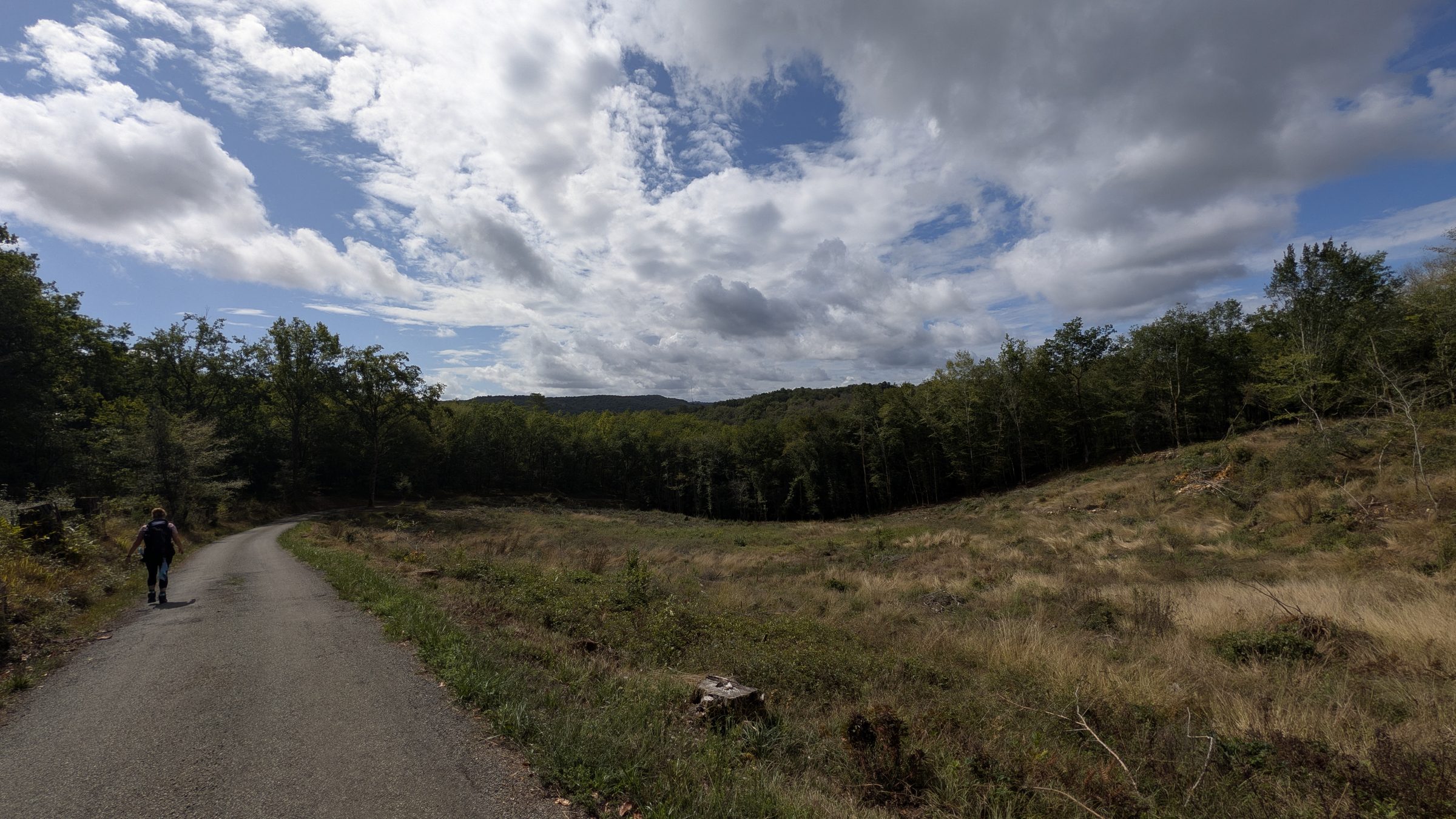
Pack light: on our holidays your luggage is moved from hotel to hotel, so during the day you only carry a small day pack with water, snacks and a waterproof. The essentials are comfortable worn-in walking shoes, layers you can add or remove, sun and rain protection, and a phone with a power bank for the GPX route files.
By Cassie ·
How your luggage works
Your bag needs to be at reception by 9am on each moving day, and it will be waiting at your next hotel. Please keep to one bag per person, up to 20 kg, so a mid-sized suitcase or holdall is plenty for a week.
Dordogne Experience is a family business, owned and run by Cassie, creating walking and cycling holidays in the Dordogne for over 40 years.

By season
Spring (April and May). Mild days that can be showery, with cool mornings. Bring a warm mid-layer, such as a fleece, and a waterproof jacket you can put on and take off as the day changes.
Summer heat (June to August). July and August average afternoon highs of around 28°C at Bergerac and Brive, and hot spells push them well past 30°C, so start early and carry more water than you think you’ll need. Light, loose clothing that covers your shoulders helps. Summer storms can be heavy but usually pass quickly, so the waterproof still comes. GOV.UK warns of wildfire risk in parts of the south-west in hot, dry spells, when forest access can be restricted at short notice.
Autumn (September and October). September is often warm and settled; October brings cooler days, shorter evenings and a little more rain. Pack an extra warm layer and something for chilly evenings on a terrace.
More on the weather month by month is on our when to go page.
Footwear
Our routes follow quiet lanes, woodland paths, some rocky paths with short climbs, and, on France’s Most Beautiful Villages, an old cobbled mule track. Comfortable walking shoes or light boots with a good grip suit most people; wear them in at home first. Bring good walking socks, ideally a fresh pair for each walking day, light shoes or sandals for the evening, and blister plasters. If you like walking poles at home, bring them: many walkers find them a help on the steeper descents.

Layers and rain gear
Layers work better than one heavy jacket: a breathable base layer, a fleece or light down layer, and a waterproof jacket, carried every day whatever the morning forecast. A rain cover for your day pack helps too.

Sun
The NHS advises spending time in the shade when the sun is strongest, using a sunscreen of at least SPF 30 with at least 4-star UVA protection, a wide-brimmed hat that shades your face, neck and ears, and sunglasses.

Ticks
GOV.UK lists biting insects and ticks among the health risks in France, and our routes pass through woods and fields. The NHS suggests covering your skin, tucking trousers into socks, wearing light colours, using insect repellent, keeping to clear paths and checking your skin and clothes after being outdoors. Pack a tick-removal tool: the French government recommends one, and French pharmacies sell them.
Your day pack and water
A small day pack holds everything for the day: water, snacks or a picnic, your waterproof, a warm layer, sun cream, a hat, any medication you need before evening, and your phone. Carry plenty of water, and more in summer. Fill up before you leave your hotel each morning. Several of our hotels have a pool, so pack a swimsuit too.

Phone, GPX app and power bank
We email you a GPX file for every day, with simple instructions for opening it in a free mapping app, alongside our detailed route notes. Download the map area before you set off and it works with no signal. Navigation uses battery, so bring a power bank and its cable. Check your roaming charges before you go: GOV.UK says surcharge-free roaming in the EU is no longer guaranteed for UK phones.

Plug adapter
French sockets are type E, at 230 volts and 50 hertz. Two-pin type C plugs fit them, as do most European type F plugs, which are made to fit both. UK, US, Australian and New Zealand plugs need an adapter, and North American devices should say 230 volts on the label.
Cash and cards
Cards are accepted in a large number of shops, hotels and restaurants in France, but shopkeepers often set a minimum amount for card payments, so carry some euros for market stalls, small cafés and village shops. Almost all French cash machines take Visa and Mastercard. Drinks with dinner are usually settled with the hotel before you leave.
Medicines
TravelHealthPro, the UK’s National Travel Health Network and Centre, advises carrying medicines in your hand luggage, in their original pharmacy packaging, with a copy of your prescription. GOV.UK notes that some medicines are regulated differently abroad. In an emergency in France, call 112.
GHIC, EHIC and travel insurance
UK visitors can apply for a free UK Global Health Insurance Card (GHIC) on the official NHS website (unofficial sites may charge a fee); it can take up to 15 working days to arrive. An existing EHIC can be used until it expires. Neither is a replacement for travel insurance, which isn’t a condition of booking with us but which we strongly recommend. Visitors from elsewhere should follow their own government’s travel advice.
Passport and border checks (UK visitors)
GOV.UK says your passport must have been issued less than 10 years before you arrive, and expire at least 3 months after the day you plan to leave. You can stay up to 90 days in any 180 without a visa.
The EU’s Entry/Exit System (EES) is now in use: on your first entry you may be asked for fingerprints and a photo. It’s free, and your record lasts 3 years. By Eurostar, Dover or the Channel Tunnel, the checks happen before you leave the UK, so allow extra time. GOV.UK doesn’t yet list ETIAS, the EU’s planned travel authorisation, as a requirement for France: check again before you travel.
What not to bring
A big rucksack, brand-new boots, guidebooks and printed maps (your route notes and GPX files cover every day) and valuables you don’t need. The one thing to add on Cycling in the Dordogne is a helmet: they aren’t included, so bring your own or hire one when the bikes are delivered.
Which holidays go there

Premium Périgord
A Gourmet Journey
6 days · from £950 per person, sharing a double/twin room
Short walks, 4.6 to 14.1 km (2.9 to 8.8 miles) a day

Castles & Caves of the Dordogne
8 days · from £995 per person, sharing a double/twin room
12.8 to 17.8 km (8 to 11 miles) a day

France’s Most Beautiful Villages
8 days · from £965 per person, sharing a double/twin room
15.5 to 23 km (10 to 14 miles) a day

Exploring Rocamadour
8 days · from £975 per person, sharing a double/twin room

Ardèche Adventure
8 days · from £985 per person, sharing a double/twin room
Our most demanding holiday

Cycling in the Dordogne
8 days · from £1,250 per person, sharing a double/twin room
Bring your own helmet
Questions
How much luggage can I bring?
One bag per person, up to 20 kg. It’s moved to your next hotel each moving day, so have it at reception by 9am.
What plug do I need in France?
French sockets are type E, at 230 volts and 50 hertz. Type C and E plugs fit, as do most European type F plugs. UK, US, Australian and New Zealand plugs need an adapter.
Do I need cash in France?
Cards are widely accepted, but shops often set a minimum for card payments, so carry some euros for markets and small cafés.
Is a GHIC enough instead of travel insurance?
No. The NHS and GOV.UK both say a GHIC is not a replacement for travel insurance.
Do I need anything new at the border?
UK visitors may be asked for fingerprints and a photo under the EU’s Entry/Exit System on their first entry. It’s free. Check GOV.UK before you travel.
More to read

When to go walking or cycling in the Dordogne
When to go walking or cycling in the Dordogne and the Ardèche, month by month from April to October, with the weather and the markets along the way.

How fit do I need to be for a walking holiday in the Dordogne?
How hard are our walking and cycling holidays? Daily distances, the biggest climb of each holiday and what each activity level means, from our own GPX tracks.
Walking in France with your dog
Bringing your dog on a self-guided walking holiday in France: dog-friendly hotels, UK pet travel rules, summer heat, ticks, caterpillars and livestock.
Your first self-guided walking holiday in France
First self-guided walking holiday in France? How it works: route notes and GPX on your phone, luggage moved, hotels booked and Cassie a call away.

What’s included in our self-guided holidays
What’s included in our self-guided walking and cycling holidays: hotels, breakfasts and most dinners, luggage moved, route notes, GPX and support.
Sources
- Dordogne Experience, FAQ (luggage, GPX app, power bank, travel insurance) (dordogneexperience.com)
- Dordogne Experience, What’s included (luggage, route notes, helmets, drinks) (dordogneexperience.com)
- Dordogne Experience, When to go (dordogneexperience.com)
- Dordogne Experience, Castles & Caves of the Dordogne (hotels with pools, daypack list) (dordogneexperience.com)
- NHS, Apply for a free UK Global Health Insurance Card (GHIC) (EHIC, unofficial sites, 15 working days) (nhs.uk)
- GOV.UK, France travel advice, health (gov.uk)
- GOV.UK, France travel advice, entry requirements (passport, 90 days, EES) (gov.uk)
- GOV.UK, Using your mobile in EU and EEA countries (roaming) (gov.uk)
- NHS, Sunscreen and sun safety (nhs.uk)
- NHS, Lyme disease (avoiding and removing tick bites) (nhs.uk)
- World Standards, Plugs and voltage in France (worldstandards.eu)
- ADAC, Frankreich: Wissenswertes (230 V, 50 Hz; type F plugs need the extra earth-pin hole) (adac.de)
- Wikipedia (Météo-France 1991 to 2020 normals), Bergerac climate (en.wikipedia.org)
- Wikipedia (Météo-France 1991 to 2020 normals), Brive-la-Gaillarde climate (en.wikipedia.org)
- GOV.UK, France travel advice, safety and security (wildfires) (gov.uk)
- info.gouv.fr, Tiques (tick-removal tool) (info.gouv.fr)
- TravelHealthPro, Medicines and travel (travelhealthpro.org.uk)
- GOV.UK, France travel advice, getting help (112) (gov.uk)
- France.fr, Money in France (france.fr)