
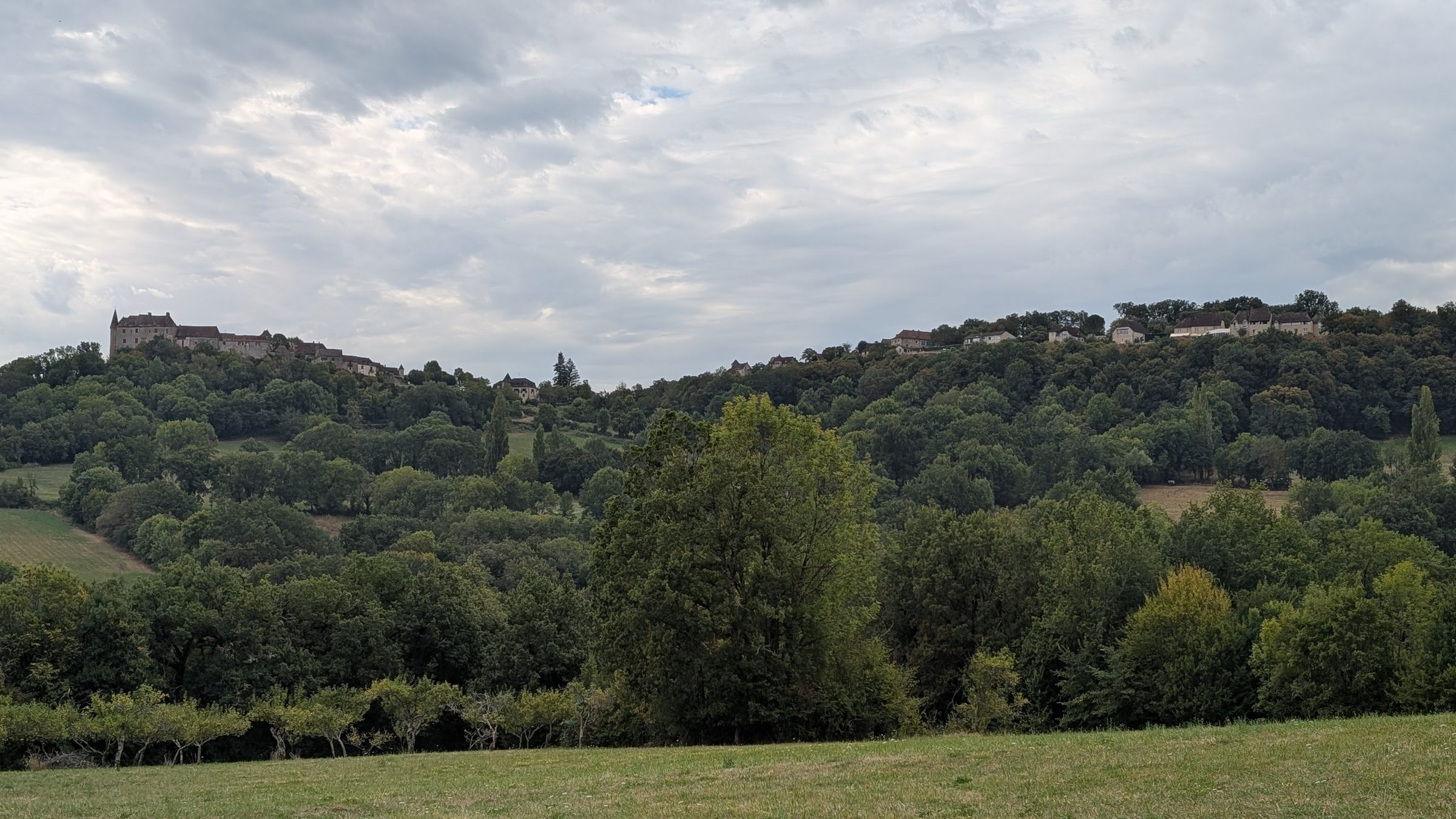
You can bring your dog on our self-guided walking holidays: most of our hotels welcome dogs for a surcharge, so please ask us first and we’ll check every hotel on your route. Travelling from the UK, your dog needs a microchip, a rabies vaccination and an Animal Health Certificate, plus a tapeworm treatment from a vet before you come home.
By Cassie ·
Which holidays and hotels
Dogs are welcome at most hotels on our walking holidays, for an extra fee. Ask before you book and we’ll confirm the whole route for your dates. Dogs can’t come on Cycling in the Dordogne.
Your luggage is moved each time you change hotel, at one bag per person up to 20 kg, so your dog’s bed and bowls need to fit in that allowance. Food is harder: GOV.UK says you can’t take meat or milk products into the EU, with exceptions such as pet food needed for medical reasons, so ask your vet and plan to buy your dog’s food in France.
Dordogne Experience is a family business, owned and run by Cassie, creating walking and cycling holidays in the Dordogne for over 40 years.

UK to France: the pet travel rules
GOV.UK sets out what you need to take a dog from Great Britain to an EU country such as France:
- Microchip: your dog must be microchipped before, or at the same time as, its rabies vaccination.
- Rabies vaccination: your dog must be at least 12 weeks old when vaccinated, and you must wait at least 21 full days after the first vaccination before you travel.
- Animal Health Certificate: it must be signed by an official veterinarian, so check your vet can issue one. Your dog must enter the EU within 10 days of the date of issue, and the certificate then covers onward travel in the EU and your return to Great Britain for a set time, which GOV.UK gives. You need a new certificate for each trip, and it can’t be used if your dog’s rabies vaccination runs out during the trip. If you live in England, Scotland or Wales, you can’t use a pet passport to enter the EU, even one issued in the EU.
- Arrival: you must enter through a travellers’ point of entry. GOV.UK limits you to 5 pets unless you’re going to an event such as a show.
Coming home, a vet must treat your dog for tapeworm no less than 24 hours and no more than 120 hours (5 days) before you arrive in Great Britain, and record it on the certificate. On a week’s walking holiday that means a vet visit in France near the end of your trip, so plan where and when well ahead. GOV.UK also advises treating your dog again within 28 days of getting home.
The UK and EU have agreed to work towards a shared agreement on animal health rules, which the government says will make taking pets to the EU easier, but nothing has changed yet. The rules can change, so check the GOV.UK pages below when you book and again before you travel. Not every way of crossing the Channel carries pets, so check with your ferry or train company too. If you’re travelling from outside the UK, different rules apply: ask your vet.

Heat in summer
Summer days in south-west France can be hot. The RSPCA warns that dogs are 10 times more likely to suffer heat-related illness from exercising in hot weather than from being left in hot cars. Its advice is to walk in the early morning or late evening when it’s cooler, test hard surfaces with your hand, and offer small amounts of water every 15 to 20 minutes. Flat-faced breeds and dogs with thick coats or health conditions are more at risk.
If your dog doesn’t cope well with heat, think about spring or autumn. Our when to go guide covers the months.

Ticks and processionary caterpillars
The French government says ticks are particularly active in spring and autumn, though they can be around all year in mild weather, in woods, scrub, tall grass, gardens and parks. It advises checking your pets after walks in wooded or grassy places, using antiparasitic products your vet recommends, and removing ticks with a tick-removal tool, which French pharmacies sell. ESCCAP UK & Ireland, a group of veterinary parasite specialists, says ticks, mosquitoes and sandflies are a problem in many parts of Europe, and that protection may need more than you use at home, so talk to your vet well before you travel.
Processionary caterpillars move in long processions and carry irritating hairs. The regional health agency for Nouvelle-Aquitaine, which includes the Dordogne, says dogs are among the first victims, because they sniff or lick the processions, which can inflame the tongue and mouth. Pine processionaries are the main species there, with the highest risk when they leave their nests in processions early in the year, into spring. The oak processionary is found mainly further north, in Poitou-Charentes, where the risk peaks in May and June. The agency’s advice is to keep away, never touch the caterpillars or nests, and if your dog has contact, don’t rub it: rinse it with plenty of water, wearing gloves, and see a vet.
Footpaths, forests and livestock
In French forests, from 15 April to 30 June, dogs must be on a lead whenever you leave the forest roads, paths and marked trails. All year round, your dog must stay under your control and within 100 metres of you. The fixed fine for breaking the spring rule is €135.
Our routes pass farms and grazing animals, so a lead near livestock and through villages is sensible. In some grazing areas, flocks are guarded by large protection dogs. Advice from France’s Mercantour National Park is to give the flock a wide berth, keep your own dog on a lead, don’t pet or feed the guard dogs, and stay calm; if you feel uneasy, back away slowly.

Places dogs usually can’t go
Many château interiors, caves and museums don’t admit dogs. The Gouffre de Padirac, which you pass on France’s Most Beautiful Villages and Exploring Rocamadour, says animals aren’t allowed. Rules differ from site to site, so check each official website before your visit, or take turns to go in.

Which holidays go there

Premium Périgord
A Gourmet Journey
6 days · from £950 per person, sharing a double/twin room
Short walks, 6 to 8 days

Castles & Caves of the Dordogne
8 days · from £995 per person, sharing a double/twin room
8 to 10 days

Exploring Rocamadour
8 days · from £975 per person, sharing a double/twin room
8 days

France’s Most Beautiful Villages
8 days · from £965 per person, sharing a double/twin room
8 to 11 days

Ardèche Adventure
8 days · from £985 per person, sharing a double/twin room
Our most demanding walk, 8 days
Questions
Can I bring my dog on a walking holiday?
Yes. Most of our hotels welcome dogs for an extra fee. Please ask first so we can check your route. Dogs can’t come on the cycling holiday.
What does my dog need to travel from the UK to France?
A microchip, a rabies vaccination at least 21 days before travel, and an Animal Health Certificate from an official vet, issued no more than 10 days before you enter the EU. Check GOV.UK for the current rules.
When does my dog need its tapeworm treatment?
A vet must give it 24 to 120 hours before you arrive back in Great Britain, so you’ll need a vet in France near the end of your trip.
Do dogs need to be on a lead in France?
In forests from 15 April to 30 June, yes, whenever you leave the paths and tracks. All year, keep your dog under control and within 100 metres.
More to read
What to pack for a walking holiday in France
What to pack for a self-guided walking holiday in France: shoes, layers, rain and sun gear, a day pack, power bank, plug adapter, medicines and GHIC.

When to go walking or cycling in the Dordogne
When to go walking or cycling in the Dordogne and the Ardèche, month by month from April to October, with the weather and the markets along the way.

Getting to the Dordogne
How to reach each walking and cycling holiday in the Dordogne and Ardèche from the UK, US, Canada and Australia, and how to get home again.

How fit do I need to be for a walking holiday in the Dordogne?
How hard are our walking and cycling holidays? Daily distances, the biggest climb of each holiday and what each activity level means, from our own GPX tracks.

What’s included in our self-guided holidays
What’s included in our self-guided walking and cycling holidays: hotels, breakfasts and most dinners, luggage moved, route notes, GPX and support.
Sources
- Dordogne Experience, FAQ (dogs) (dordogneexperience.com)
- Dordogne Experience, What’s included (luggage) (dordogneexperience.com)
- GOV.UK, Taking your pet dog, cat or ferret abroad (microchip, rabies, animal health certificate, official vet, pet passports, 5-pet limit; updated 16 October 2026) (gov.uk)
- GOV.UK, Getting an animal health certificate (gov.uk)
- GOV.UK, France travel advice, entry requirements (taking food into France) (gov.uk)
- UK Parliament written answer, Pet Travel Scheme, 18 November 2025 (UK and EU working towards a common SPS area) (westminsterbrief.co.uk)
- Government of Jersey, UK-EU Sanitary and Phytosanitary Agreement (may support the return of pet passports; expected 2027) (gov.je)
- GOV.UK, Bringing your pet dog, cat or ferret to Great Britain: tapeworm treatment (gov.uk)
- RSPCA, Dogs die on hot walks (rspca.org.uk)
- RSPCA, Keeping your dog safe in summer (rspca.org.uk)
- info.gouv.fr, Tiques: prévenir les piqûres, reconnaître les symptômes et agir (info.gouv.fr)
- ESCCAP UK & Ireland, Travelling pets advice for owners (esccapuk.org.uk)
- ARS Nouvelle-Aquitaine, Chenilles processionnaires (nouvelle-aquitaine.ars.sante.fr)
- Wikipédia, Processionnaire du pin (spring processions, danger to dogs’ tongues) (fr.wikipedia.org)
- NHS, Lyme disease (check pets for ticks after being outdoors) (nhs.uk)
- Gouffre de Padirac (official site, animals not allowed) (gouffre-de-padirac.com)
- Brive Tourisme, Gouffre de Padirac practical guide (pets not allowed) (brive-tourisme.com)
- Service Public, Promenades en forêt: chien en laisse jusqu’au 30 juin (published 11 April 2026) (service-public.gouv.fr)
- Parc national du Mercantour, Chiens de protection: les bons comportements (mercantour-parcnational.fr)